
While employers are evaluating background screening services or making policy decisions about...


Background screening in 2026 means navigating complexity at a local level. For example, “ban the box” laws have expanded to more than 30 states and 150 municipalities. Each jurisdiction has its own rules about timing, disclosures, and assessments.
The complexity becomes more evident when you account for automatic record sealing in multiple states and cities, expanded Fair Chance requirements, and tightening Fair Credit Reporting Act (FCRA) compliance expectations. Your screening policy needs to comply with all of them.
Workforce risk profiles have also shifted. Employers must ensure policies reflect modern employment screening practices, which go beyond pre-employment checks. State and local regulations now demand greater transparency with candidates, more rigorous adverse action procedures, and clearer documentation at every stage of the hiring process.
Clear, up-to-date policies protect organizations, employees, and customers while supporting equitable, consistent hiring practices.
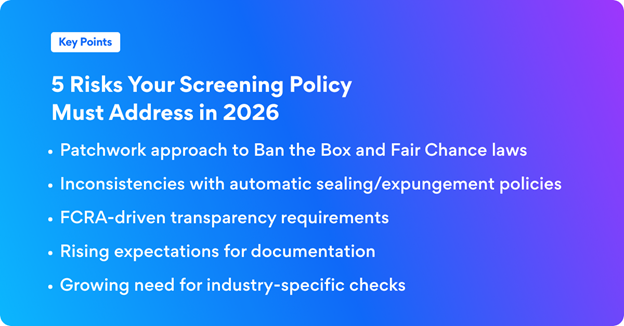
Employers face a patchwork of evolving compliance updates. While you might track every new law on your own, you should understand the major trends reshaping employment background checks.
Fair Chance and Ban the Box expansion continues. More states and municipalities now require new types of applicant disclosures or restrict when criminal history can be discussed. For example, Washington's amended Fair Chance Act prohibits criminal background questions before a conditional job offer and mandates written disclosures when adverse action occurs.
Sealed and automatically expunged records require attention. Some jurisdictions have enacted laws that automatically seal or expunge certain criminal records. Employers must avoid relying on information that shouldn’t appear during background checks.
Privacy and data handling face increased scrutiny of FCRA compliance. Some jurisdictions now require enhanced consent language, more explicit candidate notifications about what data will be collected, and more detail about how such information will be used during the background check process.
Adverse action documentation and timelines receive more oversight. Employers must ensure their adverse action notice procedures are transparent, well-documented, and compliant with evolving standards.
The takeaway: You need policies that are flexible and consistently reviewed, plus a trusted provider to help you stay compliant across regions.
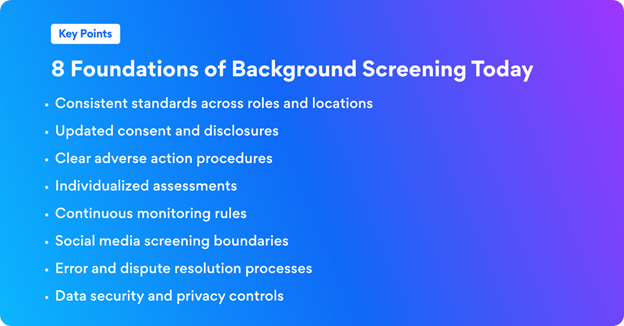
With constant updates to laws and regulations affecting screening, you can’t mess up the basics. Your background screening policy should address foundational compliance requirements and emerging considerations alike.
The following eight elements create a framework that protects your organization while treating candidates fairly throughout the hiring process.
Define which roles require which types of checks. Document these standards, and apply them consistently to reduce discrimination risk and avoid gaps in coverage. Variations create blind spots, exposing your organization to claims of selective enforcement.
Before you conduct background checks, you must disclose your intent and then obtain written authorization from the subject. Review your disclosure and authorization language regularly, as some states require updated disclosures or additional documentation.
Provide clear explanations to candidates about:
What will be checked
Why those checks are necessary
How results will be used in hiring decisions
Transparency builds trust and reduces friction in the hiring process.
Document your procedures for pre-adverse and adverse action steps. This includes:
Required adverse action notice and enclosures
Timelines for each stage
How decisions will be documented
Proper documentation supports compliance and helps defend decisions if challenged.
Most jurisdictions expect employers to consider context, job relevance, and evidence of rehabilitation when evaluating criminal history. Build this expectation into your policy to ensure compliance and fairness.
Pre-employment screening alone isn’t sufficient for many roles. Identify when ongoing checks are needed for licenses, sanctions, criminal records, or exclusion lists.
Continuous monitoring is particularly important for:
Regulated industries with strict compliance requirements
Safety-sensitive positions
Remote workforces where traditional oversight is limited
Clarify expectations for post-hire reviews, and communicate monitoring practices transparently to employees.
If your policy includes social media screening, establish clear boundaries. Restrict the screening process to job-relevant, publicly available information. Define what is off-limits to avoid collecting protected-class data or violating privacy expectations.
Background reports occasionally contain inaccurate or outdated information. Your policy should outline:
The process for candidates to dispute errors
Timelines for investigation and resolution
Communication expectations throughout the process
Supporting candidates through disputes demonstrates fairness and can prevent compliance issues.
Define how your organization will protect screening data. Elements include:
Retention timelines that align with legal requirements
Access controls that limit who can view sensitive information
Storage protocols that meet data privacy standards
Compliance with data privacy laws is non-negotiable.

Even well-written policies will fail without proper execution. Training and standardized processes ensure your screening program works as intended.
Provide regular training for HR teams, recruiters, and hiring managers. Cover consent requirements, adverse action procedures, and how to evaluate screening results appropriately. Standardize procedures for initiating checks, evaluating results, and escalating questions.
Conduct internal audits or review screening decisions to identify gaps or inconsistencies before they become bigger problems. Establish clear communication frameworks across locations and departments.
Consistency builds trust, reduces compliance risk, and ensures each candidate receives the same experience across your organization.
Generic screening policies miss critical compliance points and create gaps in your risk management strategy. Your policy should reflect the specific risks and requirements of your industry. For example:
Healthcare organizations must prioritize license and sanction monitoring, credential verification, and compliance with payer expectations. Patient safety and regulatory oversight demand rigorous screening protocols that continue after new hires start.
Transportation companies need DOT-aligned screening and ongoing monitoring of motor vehicle records. Continuous checks help identify issues before they become incidents.
Financial services firms face global watchlist reviews, identity verification requirements, and heightened privacy standards. Precision and accuracy are paramount in this heavily regulated sector.
Consider the specific regulations, risk factors, and stakeholder expectations that shape your industry. Build those considerations directly into your policy framework.
Regulations will continue to evolve. Choosing a compliance-first partner ensures alignment with changing requirements without forcing your team to become regulatory experts.
Look for a provider that offers industry-specific expertise to address the unique requirements of your sector. Find a partner that offers advanced identity verification to reduce fraud risk, continuous monitoring to identify issues in real time, and integrated technology that reduces friction for candidates and internal teams. Make sure you’ll receive proactive compliance updates, keeping you informed without tracking every regulatory change yourself.
Your screening partner should act as an extension of your compliance team, prioritizing precision, accuracy, and risk mitigation at every step.
Background screening in 2026 must continue to evolve alongside regulatory and workforce changes. Regular updates ensure your policies remain compliant, transparent, and adaptable.
A strong background screening policy is a strategic asset, not just a compliance obligation.
Build policies that reflect current requirements, anticipate emerging trends, and support consistent, fair hiring practices. When your screening program aligns with legal expectations and organizational values, you protect your workforce, your candidates, and your business.
Need help aligning your screening policy with 2026 requirements? Connect with Cisive to discuss your background screening compliance strategy.
Author: Jenni Gallaway
Bio: Content Marketing Manager at Cisive. 8 years of experience in the background screening industry.
Let's Connect on LinkedIn


While employers are evaluating background screening services or making policy decisions about...
.png?height=200&name=BLOG%20IMAGE_%20Tech%20Guru%20(Cisive).png)
You’ve seen this show before. The Detective walks into the open floor plan office shouting “I need...
While traditional background checks are a necessary first step in hiring, they only offer a...