In this Product Highlight, we’ll review key tools to consider in your screening program, as well as...


A nursing student has completed her coursework, passed her exams, and is ready to begin clinical rotations. She logs into three different portals to upload immunization records, background check results, and health documentation.
Two weeks later, she receives an email requesting documents she already submitted. Her clinical start date is pushed back. The hospital adjusts its schedule. Her program coordinator scrambles to reconcile spreadsheets across multiple systems.
This is not an isolated incident. It is the operational reality facing healthcare education programs across the country.
In October 2025, Cisive PreCheck surveyed 150 administrators and 300 students across health science programs to understand where the campus-to-clinic pipeline breaks down. The findings reveal an uncomfortable truth: the next generation of healthcare workers is not being held back by academic preparation. They are being held back by fragmented, manual processes that delay clinical readiness and strain relationships between schools, students, and clinical partners.
Healthcare programs are under intense pressure to graduate more nurses and allied health professionals. Faculty shortages, limited clinical sites, and complex onboarding requirements constrain capacity at every level.
National data indicate that nursing programs frequently turn away qualified applicants due to insufficient faculty, inadequate clinical placements and capacity constraints.
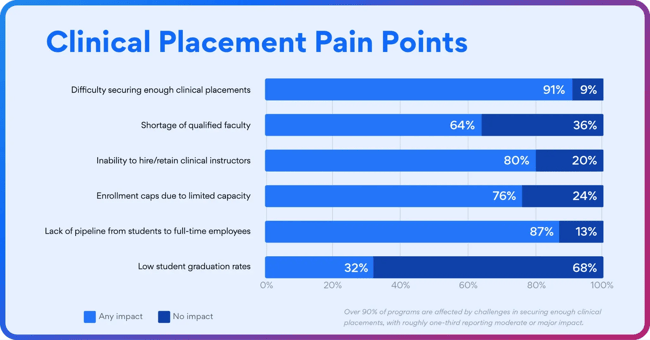
Our research confirms that clinical placements have become the primary operational bottleneck.
Thirty percent of administrators identified clinical placements as the single biggest inefficiency in their programs—more than faculty shortages, technology issues or scheduling constraints.
Over 90% reported that difficulty securing enough clinical placements has at least some impact on their operations.
The issue is not a lack of clinical partners. Ninety-six percent of administrators describe their relationships with clinical sites as good or excellent, with many reporting that those relationships are getting stronger.
The breakdown occurs in the handoff between systems and stakeholders—the process of clearing students for placement.
Nearly all administrators report that students face at least occasional delays due to clinical site onboarding or documentation issues. These delays create a domino effect:
When clinical capacity is already limited, every preventable delay compounds the problem.
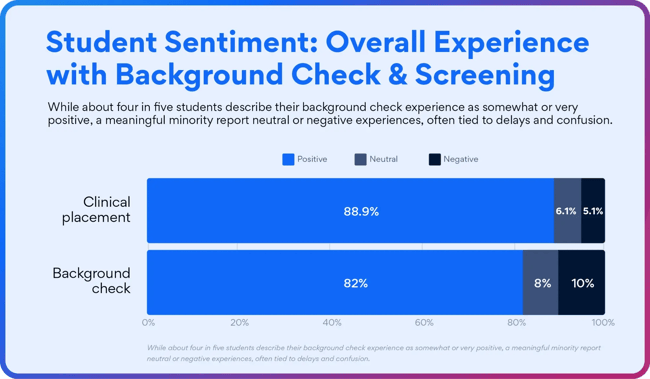
Among students who had begun clinical placement approval or onboarding, 88.5% encountered at least one challenge.
The most common pain points included:
Students described being asked to upload the same documents multiple times. They reported confusion about their clearance status, even as clinical start dates approached.
Many cited disorganized placement processes, unclear communication from staff and faculty, and difficulty accessing or uploading required documents.
These are not minor inconveniences. Delays in clinical clearance affect students' ability to complete rotations on time, jeopardizing graduation timelines, licensure eligibility, and job placement. For students balancing work, family, and education, uncertainty about clinical readiness creates stress and financial strain.
The experience mirrors international research on nursing and health science students, who frequently cite inadequate communication, limited access to placements, and administrative hurdles as major stressors during clinical training.
One in four students reported repeated requests for the same information, difficulty uploading documents, and technical issues with screening platforms.
The students themselves can see the solution. When asked what would most improve the process:
Both students and administrators are asking for the same thing: consolidation and clarity.
The fragmentation problem is structural. Most programs rely on multiple vendors to manage background checks, drug testing, immunizations, and clinical placement. Only about a quarter use a single platform for all requirements. Nearly all students (99.3%) navigated more than one system during screening, with the vast majority using two to four platforms.
In practice, this often looks like:
The result is a patchwork of systems that do not communicate with each other.
Administrators are forced to manually reconcile data. Students upload the same documents multiple times. Clinical partners wait for status updates that should be automatic.
Administrators identified turnaround time delays as their biggest frustration with current screening processes. Other top concerns included:
Nearly 60% said that easier integration with institutional and clinical systems would most improve their screening process. Thirty-one percent specifically want a single, unified platform for all screening tasks.
The regulatory environment adds another layer of complexity. Healthcare education programs must align with state boards, accreditation bodies, and clinical site policies covering criminal background checks, drug screening, immunizations, and evolving infection control standards.
Administrators highlighted:
In this context, the case for a unified screening platform is not just about convenience. It is about risk management, compliance consistency, and the ability to scale programs without overwhelming staff.
The operational friction documented in our research is solvable. Programs can reduce delays and stress by taking concrete steps to streamline the campus-to-clinic pipeline.
These steps are actionable, implementable changes that address the root causes identified by both administrators and students in our research.
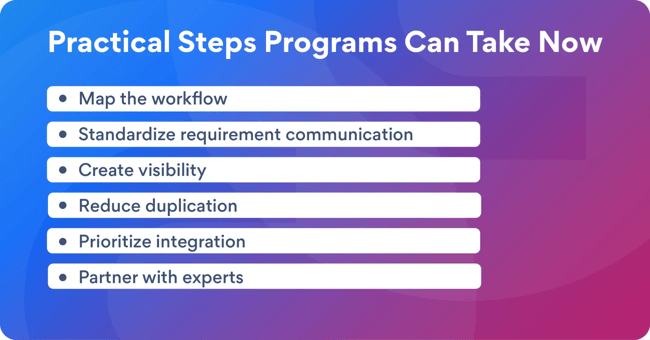
Programs looking to modernize their screening process need a unified, human-centered platform that consolidates screening, compliance documentation, and readiness visibility in one experience.
StudentCheck addresses this need by bringing background checks, drug testing, immunization tracking, and clinical placement readiness into a single platform. It integrates with clinical placement systems, provides real-time status tracking for students and staff, and automates reminders and expiration notifications.
The platform is built for the realities of healthcare education—designed to reduce friction for overwhelmed students and overextended coordinators while maintaining compliance rigor.
For programs exploring modernization, StudentCheck offers a practical example of how consolidation and clarity can improve outcomes for students, schools, and clinical partners.
The healthcare workforce crisis is well-documented. What is less visible is how operational inefficiencies in the campus-to-clinic pipeline are amplifying that crisis.
Our research shows that students are ready to learn and serve, but outdated, fragmented screening and onboarding processes are slowing them down.
The good news is that these problems are fixable. The solutions do not require reimagining healthcare education from the ground up. They require consolidating systems, clarifying requirements, and adopting more unified, student-centered workflows.
Programs that modernize now will be better positioned to attract students, strengthen clinical partnerships, and feed a strained healthcare labor market with practice-ready professionals.
In an environment where clinical capacity is already constrained by faculty shortages and limited sites, every avoidable delay matters.
Reducing friction in the campus-to-clinic pipeline is not just an operational improvement. It is a strategic investment in the future healthcare workforce.
Want to see how your program compares? Download the free benchmark report to explore the full research findings. If you are ready to reduce delays, simplify compliance, and give students and clinical partners a smoother experience, talk with a PreCheck expert about how StudentCheck can help modernize your screening infrastructure.
Author: Matt Jaye
Bio: Healthcare Student Screening Expert at Cisive PreCheck. Proud Husband, Dad of 2, & Lacrosse Stats Whisperer.
Let's Connect on LinkedIn


In this Product Highlight, we’ll review key tools to consider in your screening program, as well as...
.png?height=200&name=BLOG%20IMAGE_%205%20Takeaways%20from%20Roundtable%20(PreCheck).png)
PreCheck recently hosted a Healthcare Roundtable for industry leaders in talent acquisition and...
If your organization receives federal funds, you must include sanctions screening as part of your...