
In the financial services industry, where trust, compliance, and accuracy are paramount, staying...


Financial institutions face a unique challenge: hiring quickly to stay competitive while meeting some of the strictest compliance standards in any industry. Traditional background checks provide valuable information, but they can leave gaps that create risk for organizations entrusted with customer assets, sensitive data, and market integrity.
In financial services, one misstep in screening can lead to regulatory penalties, reputational damage, or worse. That's why fingerprinting has become a cornerstone of hiring compliance for banks, broker-dealers, investment advisers, and other regulated entities.
By linking an individual's identity to unique biometric data, fingerprinting ensures that criminal history records match the right person and closes the gaps that name-based searches can miss. Far from being just a regulatory checkbox, fingerprinting is a frontline defense for organizational integrity, customer trust, and regulatory compliance.
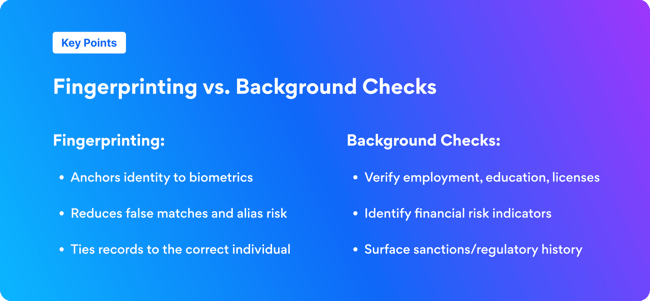
In financial services hiring, fingerprinting and traditional background checks serve different purposes, and together they create a stronger safeguard. Fingerprint background checks for employment anchor identity to biometrics, while traditional checks provide broader context about qualifications and history.
If you are comparing methods within your screening program, it helps to understand how fingerprint background checks for employment complement name- and SSN-based searches.
Fingerprint-based background checks verify identity using a candidate's unique biometric markers. Once captured, the prints are submitted electronically to authorized state or federal repositories, including the Federal Bureau of Investigation's Integrated Automated Fingerprint Identification System (IAFIS) or through intermediaries like FINRA for securities industry roles. Results are then matched against criminal record databases, ensuring that offenses tied to an individual surface quickly and accurately.
Because this process relies on biometric data, it significantly reduces the risks of identity manipulation or false matches that can occur with name-based searches. In financial services, this is particularly important when screening individuals who may have access to customer funds, sensitive financial data, or positions of fiduciary responsibility.
Fingerprinting also provides an extra layer of assurance that the person you are hiring is exactly who they claim to be, with no room for aliases or falsified credentials to slip through.
Still, the fingerprinting process can involve regulatory-specific steps, appointment logistics, and technology vendors, which is why execution matters. Fingerprint submission quality, correct data entry, and compliance with jurisdictional rules all influence turnaround times. For organizations hiring across multiple states or regulatory frameworks, planning for the complexities of fingerprinting is key to keeping onboarding efficient while staying compliant.
Standard background checks for financial services professionals cast a wider net by examining a candidate's personally identifiable information, such as name, date of birth, and Social Security number. These checks surface professional history and risk indicators that biometrics alone do not provide, including:
Employment and education verifications
Professional license status and regulatory registrations
Credit history and financial responsibility indicators
Sanctions and exclusion lists (such as FINRA disciplinary actions, OCC enforcement actions, or OFAC lists)
Civil litigation or bankruptcy records
Records that do not make it to the FBI systems
In financial services, these records are critical. A broker with undisclosed regulatory sanctions or a loan officer with a recent bankruptcy may not be flagged through fingerprinting alone, but would be identified in a comprehensive background check. This makes traditional screening indispensable for verifying professional qualifications, regulatory compliance, and overall suitability for roles involving customer trust and financial transactions.
Because these checks depend on the accuracy of the data provided, there is always a risk of gaps or omissions. For example, a candidate can fail to disclose previous addresses or may use variations of their name. Pairing traditional checks with fingerprinting ensures both certainty of identity and a more complete review of history. Together, they form a layered safeguard that reduces hiring risk, supports compliance, and builds trust with customers, regulators, and shareholders alike.
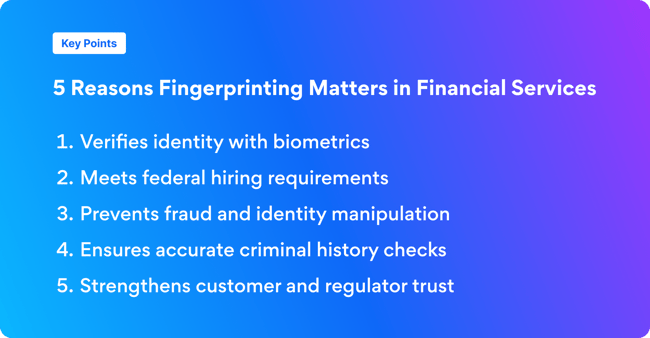
Hiring in financial services cannot only be about filling positions quickly. Financial services leaders must make it a priority to safeguard customers, ensure regulatory compliance, and protect the integrity of their institutions. Fingerprinting plays a central role because it provides certainty in identity verification and helps organizations close the gaps that traditional background checks alone cannot.
The most fundamental reason for fingerprinting in financial services is regulatory compliance. Federal law mandates fingerprint-based background checks for specific roles and institutions.
Under Section 19 of the Federal Deposit Insurance Act, banks and FDIC-insured institutions must conduct fingerprinting background checks to identify individuals with convictions involving dishonesty, breach of trust, or money laundering.
Similarly, Section 17(f)(2) of the Securities Exchange Act requires broker dealers, funding portals, transfer agents, and clearing agencies to fingerprint partners, directors, officers, and employees. These fingerprints are submitted through FINRA and then to the FBI for processing.
Mortgage lenders must comply with the Secure and Fair Enforcement for Mortgage Licensing Act (SAFE Act), which requires state-licensed loan originators to submit fingerprints through the Nationwide Multistate Licensing System (NMLS).
For financial institutions, meeting these requirements is not optional. Failure to comply can result in significant penalties, loss of regulatory approvals, and reputational harm. Many organizations require fingerprints as part of routine hiring to ensure they meet federal standards from the start.
Identity theft is a persistent risk in hiring, and it poses a particular challenge for financial institutions. Applicants may attempt to use stolen or falsified credentials to obtain roles that provide access to customer accounts, financial systems, or confidential data. Fingerprinting prevents this by linking an individual to their unique biometric markers, ensuring that the person presenting the paperwork is the same person tied to official records.
This gives HR and compliance teams confidence that hiring decisions are grounded in verified facts. For financial institutions facing competitive hiring markets, avoiding false hires also saves valuable time and resources that would otherwise be wasted on onboarding unqualified or fraudulent candidates.

Traditional background checks rely on names, dates of birth, and Social Security numbers, which can be incomplete or deliberately manipulated. Fingerprinting removes this uncertainty by matching candidates against state and federal criminal databases.
This ensures that offenses such as embezzlement, wire fraud, identity theft, or financial crimes are correctly attributed to the right individual. For financial employers, this accuracy is essential not only to protect customers but also to uphold trust with regulators, investors, and accrediting bodies that demand strict due diligence.
Every financial institution's reputation depends on the confidence of customers, shareholders, and the broader community. Fingerprinting demonstrates that an organization takes security seriously and is committed to the highest level of vetting.
In an era where data breaches and financial fraud strain customer confidence, reinforcing trust through thorough screening can set a financial institution apart. It also provides assurance to boards, investors, and regulators that hiring processes meet the highest standards of accountability.
The ultimate goal of fingerprinting is to protect customers and institutional assets. By ensuring that employees and contractors have been accurately screened, organizations reduce the likelihood of bringing individuals with a history of financial crimes into direct contact with customer funds or sensitive information.
In practice, this creates a culture of integrity across the workforce, where employees know their colleagues have been thoroughly vetted. That assurance supports stronger teamwork, reduces turnover, and contributes to a safer environment for conducting business.
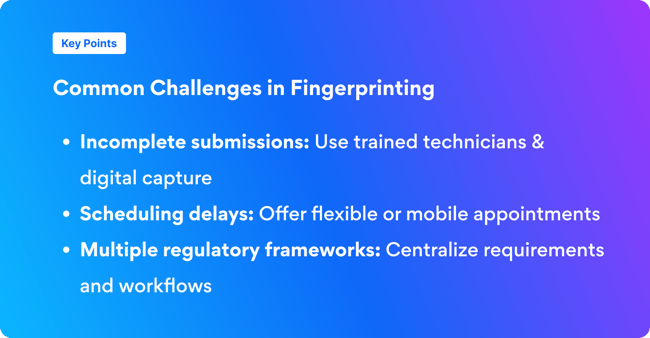
Even with its clear advantages, fingerprinting can introduce complications that slow down hiring and frustrate both candidates and HR teams. From technical errors to scheduling bottlenecks, these issues are common across the financial services industry. The good news: each has a practical solution when addressed proactively.
Fingerprints that are smudged, unclear, or missing data points can result in rejections from state and federal systems. Every rejected submission delays onboarding, which can lead to staffing gaps in critical roles, increased workload for current employees, and missed business opportunities.
To prevent this, organizations should ensure candidates are guided through the capture process with clear instructions and access to trained technicians. Live scan fingerprinting technology further improves accuracy by capturing high-quality digital prints that are transmitted electronically to law enforcement agencies.
In busy markets, scheduling fingerprinting appointments can take days or even weeks, creating a bottleneck in the hiring timeline. For financial institutions facing urgent staffing needs or competitive talent markets, these delays are costly.
One way to solve this is by working with vendors that offer flexible scheduling, mobile fingerprinting units, or integrated appointment booking systems that allow candidates to secure time slots early in the hiring process.
Fingerprinting rules vary widely across jurisdictions and regulatory bodies. Some roles require checks through state bureaus in addition to FBI databases, while others mandate submissions through FINRA, NMLS, or other intermediaries. Each framework has its own forms, turnaround timelines, and submission requirements.
For multi-state financial institutions or those operating across securities, banking, and mortgage lending, this patchwork can complicate compliance and slow onboarding, especially when HR teams manage requirements manually.
Establishing a centralized compliance framework, ideally supported by a partner experienced in financial services regulations, helps track and standardize requirements across locations and business lines. This approach not only reduces the risk of errors but also improves consistency, ensuring that all candidates meet the same safety and compliance thresholds regardless of where they are hired or which regulatory framework applies.
Fingerprinting is a regulatory requirement, a safeguard for customers, and a foundation for compliance in financial services. When paired with traditional background checks, it ensures both accurate identity verification and a full view of a candidate's history.
Yet as we have seen, the process is not without challenges: incomplete submissions, scheduling delays, and a complex web of federal and state requirements can all slow down hiring.
That's where Cisive comes in. As a trusted screening partner in financial services, Cisive provides fingerprinting services that simplify and accelerate the process without sacrificing accuracy or compliance. From guiding candidates through fingerprint submission to managing multi-jurisdictional requirements, Cisive delivers a streamlined experience that protects your customers, reduces administrative burden, and keeps your workforce moving forward.
Ready to strengthen your hiring process? Explore how Cisive's fingerprinting solutions can help you hire with confidence and safeguard the integrity of your team. Speak to a screening pro today to learn more.

Author: Vaun Longhorn
Bio: Background screening expert with expertise in financial services at Cisive.
Let's Connect on LinkedIn


In the financial services industry, where trust, compliance, and accuracy are paramount, staying...

Vendor relationships are the backbone of modern financial services operations, handling such areas...

An employee’s integrity is every bit as important as their skills. If you’re involved in hiring,...