At PreCheck, we’ve noticed that a large number of our healthcare clients have initiatives in place...


Your new nurse accepts the offer on Monday. By Wednesday, they’re already frustrated. They entered license information during the application process, but credentialing is asking for it again. By Friday, your compliance team is still searching for missing data, and your latest hire is wondering whether your organization always operates like this.
This scenario plays out every day at many healthcare organizations running Workday. Leaders believe they've built an integrated, efficient hiring process. What they don't see is what’s causing credentialing workflows to revert to manual tracking, duplicate data entry, and disconnected tools.
That disconnect creates three critical problems:
Candidates face unnecessary friction at the start of employment
Compliance teams manage thousands of licenses in spreadsheets outside your system of record.
The handoff between recruiting and credentialing requires manual intervention that slows hiring and increases risk.
This article examines where Workday credentialing workflows typically remain manual, what a true integration should deliver, and how healthcare organizations can finally bring license monitoring and primary source verification directly inside the platform they already use.
Healthcare leaders choose Workday to eliminate inefficiency. Yet credentialing workflows often remain stubbornly manual, even when the rest of the hiring process flows smoothly. Here are the pain points that persist.
Candidates submit license and certification information during the application process. Then, once they move into onboarding or credentialing, they're asked to re-enter the same details.
This creates friction at the worst possible moment. Instead of getting to work, new hires face another round of data entry. The reaction is predictable: "Oh, more data entry."
That frustration erodes trust and momentum right when organizations should be building engagement.
Many clinical departments maintain separate rosters that track thousands of licenses. These spreadsheets lack real-time updates, audit trails, or automated monitoring. When you're managing so many licenses manually, the risks quickly compound.
Spreadsheets are difficult to secure, easy to corrupt, and commonly out of sync with your HR information system. Even a single missed expiration or undetected suspension can expose your organization to regulatory penalties and patient safety risks.
Workday Recruiting captures license data during the hiring process. But credentialing teams don’t always receive that data cleanly. That leads to manual outreach, with recruiters, HR staff, and credentialing analysts redoing work that shouldn’t be repeated.
When the left hand doesn't talk to the right hand, the result is wasted time, delayed onboarding, and increased administrative burden across multiple departments.
Some credentialing vendors advertise Workday integrations, but the reality often falls short of expectations. What looks like a button inside Workday instead opens the vendor’s product in a new browser tab.
Instead of full integration, you still need separate login credentials to do work in a different system. Such a two-step process defeats the purpose of integration. It's not a true Workday experience, and it doesn't eliminate manual effort.
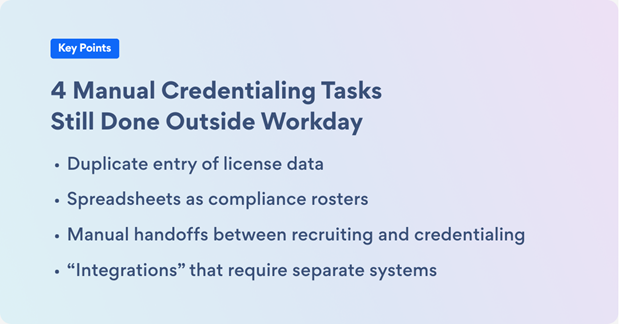
The gap between expectation and reality is wide. Healthcare teams assume their Workday implementation includes credentialing. What they discover is that credentialing remains a disconnected process requiring separate tools, manual tracking, and constant reconciliation.
A true integration should deliver a fundamentally different experience. Here are five traits to look for in your integration.
No system hopping. No additional logins. Workday behaves like the system of record because it is the system of record.
Administrators stay in the environment they already use daily. Credentialing becomes part of the standard workflow rather than a separate task requiring different tools and processes.
License and certification details flow from Workday Recruiting directly into the credentialing workflow. Applicants never re-enter the same information. Data quality improves because there's a single source of truth.
Accuracy increases and frustration decreases when information is captured once and used across systems. Your team benefits, and so do your candidates.
When an applicant becomes an employee, the system creates credential records automatically. No batch updates, spreadsheet reconciliation, or roster management needed.
This is where manual credentialing truly disappears. The transition from candidate to employee triggers credentialing workflows without any human intervention.
Suspensions, expirations, and board actions surface immediately in your system. This gives administrators the information necessary to remove an employee from clinical duties quickly.
By contrast, monthly batch checks leave dangerous gaps. A nurse whose license is suspended on January 3, for example, shouldn't continue practicing until the next scheduled review. Real-time monitoring closes that window of risk.
License statuses, expiration dates, and primary source verification (PSV) results appear directly in Workday. Scheduling systems, access control tools, and compliance dashboards all stay in sync with credential status.
This bidirectional data flow ensures consistency across every system that relies on licensure information. When one system updates, all systems reflect the change.

The challenge is clear. The next question is how to solve it.
LicenseManager Pro (LMP) from Cisive PreCheck delivers the capabilities that healthcare organizations need to eliminate manual credentialing workflows while staying inside Workday.
LMP performs PSV for more than 3,000 license and certification types. Automation occurs wherever possible, with manual verification when sources require it. Real-time alerts notify administrators of disciplinary actions and status changes.
Healthcare credentialing requirements vary widely by role, state, and specialty. LMP handles that complexity without requiring your team to become experts in every licensing board's verification process.
The License Requirement Table automatically assigns required license types based on job code. This eliminates guesswork, inconsistent rules, and departmental variation.
When a new employee gets hired into a specific role, the system knows which credentials are required and automatically initiates verification. Compliance becomes consistent across the organization.
LMP ensures that HR, credentialing, scheduling, and access control systems each receive consistent information. The integration eliminates manual updates and aligns every downstream system with the latest credential status.
When a license expires or a disciplinary action occurs, the entire organization responds to credentialing changes in real time. Such information immediately flows back into Workday. Scheduling systems can prevent shifts from being assigned to affected employees. Access control systems can suspend permissions.
Candidate license data collected in Workday flows directly into LMP for credentialing. Resume parsing minimizes re-keying at the applicant stage.
The candidate experience improves dramatically. Instead of filling out the same information multiple times, applicants provide their details once, efficiently moving to the next stage of the hiring process.
LMP provides full documentation of PSV, including timestamps and renewal history. When auditors arrive, you present clean, comprehensive records rather than spreadsheets.
No more nightmares about presenting unverified spreadsheets during a Joint Commission survey. Instead, you demonstrate a controlled, documented, and compliant process, complete with full audit trails.
LMP captures daily changes rather than monthly snapshots. Suspended or sanctioned staff cannot continue practicing without detection.
This shift from periodic checking to continuous monitoring fundamentally changes your risk profile. Compliance becomes proactive rather than reactive.
Large healthcare facilities managing tens of thousands of licenses often discover significant issues when transitioning from spreadsheets to automated credentialing, including:
Broken and duplicate records. The same employee appears multiple times because of variations in name spelling, different employee IDs, or conflicting license numbers.
Missing credential information. Employees hired years ago may have incomplete records. License numbers were never fully captured. Expiration dates show as blank cells.
Inconsistent data formats. One department tracks licenses by state abbreviation, another uses full state names. Date formats vary across spreadsheets.
Outdated or incorrect license numbers. Staff provided license information years ago but renewed under different numbers. The spreadsheet was never updated.
These discoveries, while initially challenging, represent a critical opportunity. Organizations can finally view the scope of their compliance gaps rather than operating with partial visibility.
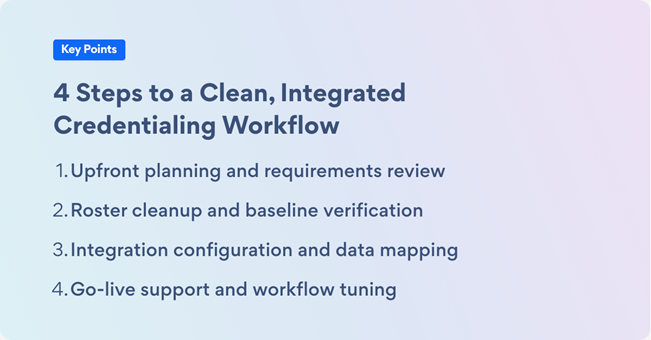
PreCheck handles the heavy lifting during implementation, minimizing the burden on internal teams. The process follows a structured approach:
Upfront planning and data review. An implementation specialist works with your team to understand current credentialing requirements, job code structures, and roster organization. This planning phase identifies which licenses need PSV, how frequently verification should occur, and what notification workflows make sense for your organization.
Roster cleanup and baseline verification. PreCheck receives roster data via secure file-transfer protocol (FTP), reviews it for errors and inconsistencies, and works with your team to correct records before verification begins. Once the roster is clean, a baseline search establishes the current status of every credential.
Integration configuration. Technical teams configure the bidirectional data flow between LMP and Workday. This step maps job codes to license requirements through the License Requirement Table and establishes automated roster creation for new hires. It also creates write-back protocols so credential status updates appear in Workday immediately.
Go-live support. During the first weeks after launch, PreCheck monitors the system closely, addresses workflow adjustments, and trains your team on how to access dashboard reports, respond to deficiency notifications, and manage exceptions.
The most common feedback from organizations post-implementation: "We didn't realize how much manual work we were doing until it stopped."
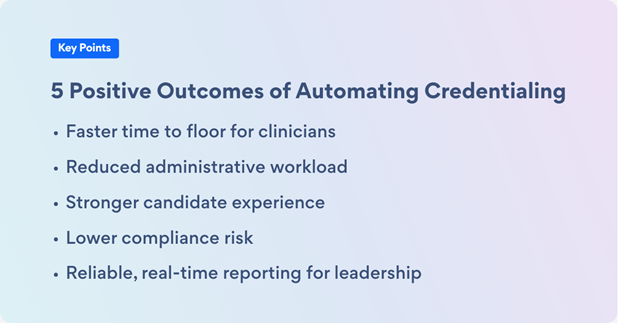
Features and implementation matter, but outcomes matter more. When credentialing moves inside Workday with LMP and automation replaces manual processes, healthcare organizations experience measurable improvements across operations and compliance.
Speed up onboarding by removing duplicate entries and manual roster creation. Every day shaved off the process increases care capacity and reduces reliance on expensive contract labor.
In a tight labor market, speed matters. The faster you can move qualified candidates from offer to active practice, the more competitive your organization becomes.
Shift your credentialing teams from manual data entry to oversight and quality control. Meanwhile, HR and talent acquisition staff don’t have to chase missing information and manage handoffs.
When systems handle routine verification automatically, your team focuses on exceptions, improvements, and strategic initiatives rather than repetitive administrative work.
Candidates submit information only once, and they move through the hiring process with confidence. A smooth experience supports retention and strengthens your employer brand in a competitive healthcare labor market.
Every touchpoint matters. When candidates encounter friction, they question whether your organization values their time. When the process is seamless, they start their employment with a positive impression.
Deploy real-time PSV to ensure no one practices with an expired or suspended license. Clean, centralized records streamline Joint Commission audits and CMS surveys.
Compliance isn't just about avoiding penalties. It's about protecting patients, maintaining accreditation, and operating with integrity. Automated credentialing strengthens all three.
Make Workday the single source of truth, and you’ll help leadership visualize clear credential statuses across the workforce. Reporting becomes reliable. Planning becomes informed. Risk becomes visible and manageable.
Decisions about staffing, expansion, and compliance strategy all improve when the underlying data is accurate, current, and complete.
Healthcare credentialing is too important to remain manual. The consequences of expired licenses, undetected sanctions, and incomplete verification extend beyond administrative inconvenience. Credentialing mistakes affect patient safety, regulatory standing, and organizational reputation.
The Workday ecosystem provides the foundation for modern HR operations. But without true integration, credentialing will remain disconnected, manual, and risky.
LicenseManager Pro embeds credentialing directly inside Workday. Healthcare organizations finally unify hiring, credentialing, and compliance inside the system they already use every day.
The result is safer care, stronger compliance, and a smoother experience for everyone involved.
Ready to eliminate manual credentialing workflows? Learn more about bringing LicenseManager Pro into your Workday environment. Contact PreCheck to schedule a conversation with our team.


At PreCheck, we’ve noticed that a large number of our healthcare clients have initiatives in place...
As a healthcare organization, it's your responsibility to keep your staff and patients safe by...

This year has had its fair share of devastating storms and wildfires, highlighting the importance...