Keeping your fleet compliant and your drivers safe is a critical element of your fleet management....


Every passenger who boards a motor coach makes an implicit assumption: the driver has been screened, vetted, and cleared to operate that vehicle safely. For fleet operators, that assumption creates a legal and contractual obligation that extends far beyond regulatory minimums.
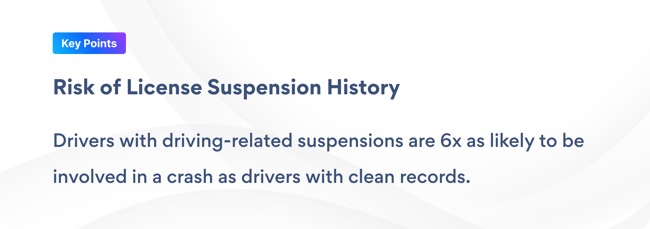
Driver background screening determines who sits behind the wheel and, by extension, who is responsible for dozens of lives at a time. The drivers you hire directly influence crash rates, insurance premiums, contract renewals, and your defensibility when incidents do occur. Research shows that commercial drivers who are suspended for driving reasons are several times more likely to be in crashes.
For operators transporting school groups, medical passengers, or corporate clients, comprehensive transportation background screening isn’t just a compliance formality. It’s the most effective risk control you can implement.
Bus and motor coach operators face mounting pressure from regulators, insurers, and passengers to demonstrate that every driver is thoroughly vetted. The Department of Transportation's 2025 Progress Report on the National Roadway Safety Strategy emphasizes the need for robust safety measures across commercial vehicle operations, including passenger carriers.
According to FMCSA commercial motor vehicle data, large buses and motor vehicles are involved in thousands of crashes annually, with passenger injuries and fatalities representing preventable losses tied directly to driver qualification failures. Transportation statistics show that intercity and charter bus operations continue to grow, expanding the potential passenger base and potential liability exposure for operators that fail to effectively conduct background checks.
Safety audits of motorcoach operators have repeatedly uncovered violations of required safety practices, including driver qualification issues. These gaps in vetting and oversight are directly linked to safety deficiencies that put passengers in harm's way. For fleets transporting school groups, tourists, or medical passengers, a single high-risk driver can be responsible for dozens of lives, multiplying the impact of any screening failure.
Motorcoach security guidance from the Transportation Security Administration calls for identity verification and pre-employment screening policies that define disqualifying offenses and include a process for reviewing adverse findings. These background check requirements are increasingly echoed in contracts with school districts, universities, corporate shuttle programs, and tour operators.
Incomplete screening can place fleets out of compliance and at contractual risk, threatening revenue and reputation.
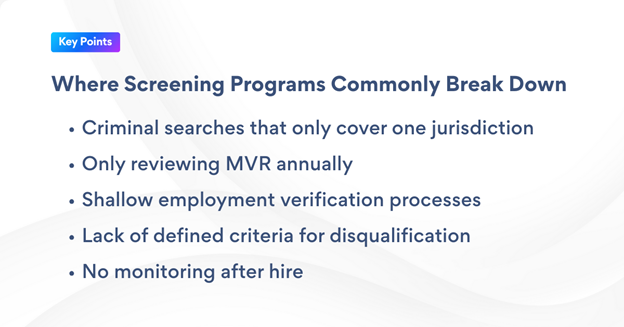
Many bus and motor coach operators maintain screening programs that fall short of best practices, despite knowing the regulatory requirements and risk factors. Common gaps include:
Incomplete criminal history searches that miss multijurisdictional records or fail to check federal databases
Superficial employment verification that doesn’t probe prior safety violations, terminations, or performance issues
Infrequent motor vehicle record monitoring that allows new violations to accumulate between annual reviews
Failure to verify application accuracy, despite industry data suggesting that roughly one-third of job applicants misrepresent information
Lack of defined disqualification criteria, leaving hiring managers to make subjective decisions
Lack of post-hire monitoring protocols to identify drivers whose records deteriorate after hire
Investigations will uncover incidents in which bus drivers with undisclosed convictions, falsified applications, or unverified employment histories became involved in serious crashes after slipping through inadequate driver background checks. These hiring decisions could likely have been prevented via basic measures, such as checking multistate criminal records, verifying past employers over the required look-back period, or reconciling application gaps.
State audits have identified serious gaps, such as agencies lacking complete criminal history data or failing to receive required felony arrest notifications for licensed school bus drivers. These audits explicitly warn that such blind spots can jeopardize children's safety.
From a risk management perspective, rigorous passenger safety background check programs are strongly linked to reduced accident exposure, lower legal and insurance costs, and improved fleet safety metrics. Small high-risk subgroups account for a disproportionate share of crashes. By excluding or closely managing those individuals, employers gain outsized safety benefits for passenger operations.
Courts examine whether an employer conducted reasonable due diligence before hiring and retaining drivers. Background checks help maintain defensibility in the event of an incident, reducing exposure to claims of negligent hiring and negligent retention. When discovery reveals that a driver involved in a serious crash had disqualifying red flags that standard screening would have surfaced, settlement demands and reputational damage escalate rapidly.
Insurers evaluate screening rigor as part of their underwriting process. Carriers that demonstrate disciplined driver qualification processes, including comprehensive background check services, ongoing MVR monitoring, and clear disqualification criteria, are more likely to secure favorable premium rates and avoid non-renewals.
Demonstrable compliance with Department of Transportation (DOT) and state screening requirements strengthens a carrier's competitive position when bidding for contracts with school districts, corporate clients, and tour operators. Clients increasingly demand safety documentation in requests for proposals. Even a single publicized incident involving an inadequately screened driver can result in contract terminations and lasting brand damage.
The cost of comprehensive ride-hailing driver screening and mobility service driver verification is modest compared to the cost of an accident or lawsuit. Legal fees, settlements, increased insurance premiums, lost contracts, and reputational harm from one preventable incident far exceed the investment in implementing and maintaining a rigorous screening program.
The business case for screening is clear. The question becomes how to build a program that delivers these outcomes without creating operational bottlenecks or compliance gaps.

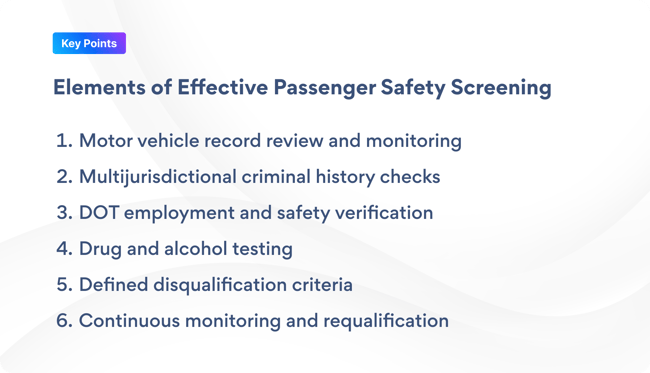
Effective background screening programs in bus and motor coach fleets combine several elements, each of which maps to known risk factors:
Reviewing state driving histories will flag patterns of speeding, serious moving violations, and past crashes, which are associated with elevated future crash risk. A comprehensive criminal record check of driving history helps identify drivers with unsafe patterns before they transport passengers. Leading passenger carriers require ongoing MVR monitoring, often twice per year or more, to catch new violations quickly.
Multijurisdictional criminal background checks detect violent, sexual, drug, or theft offenses that may be incompatible with unsupervised access to passengers. These checks include searching criminal records across state and federal databases. Sometimes, these checks are paired with identity verification to confirm accuracy. In some states, school bus drivers must pass state police and FBI criminal checks and child abuse registry clearances before transporting students. Motor coach operators transporting vulnerable populations should apply similar standards.
DOT background checks require contacting prior employers, typically over the last three years or more, to verify experience, performance, and any drug or alcohol violations. This process helps prevent drivers with poor safety records from "job hopping" between carriers without disclosure.
Pre-employment, random, post-accident, and reasonable suspicion testing are mandated for safety-sensitive DOT positions to reduce substance-related crashes. For non-emergency medical transport and similar operations, screening for substance use is emphasized because passengers are often medically fragile or vulnerable.
Clear, documented standards for what constitutes a disqualifying offense or violation ensure consistent hiring decisions and reduce subjective judgment errors. Criteria should incorporate driver's license verification requirements and be reviewed annually to reflect regulatory changes and claims experience.
Post-hire monitoring protocols, including ongoing monitoring of the MVR for violations and status changes, continuous criminal activity monitoring, annual MVR reviews and ongoing drug testing, surface risks that develop after a driver joins the fleet. Requalification triggers such as new violations or failed drug tests should prompt immediate review and, if necessary, driver suspension or removal.
The best driver background screening solutions integrate these components into a streamlined workflow that reduces time to hire while maintaining accuracy and compliance. Your screening solution should support continuous monitoring, automated compliance alerts, and audit-ready documentation. Operators with international drivers or cross-border operations should add international background screening capabilities to ensure compliance across jurisdictions.
Leading motor coach operators track the effectiveness of their screening programs through metrics that demonstrate safety improvements, cost savings, and operational efficiency gains. Key performance indicators include:
Reduction in crash frequency and severity compared to baseline periods before implementing enhanced screening
Decrease in insurance claims and premium costs attributable to improved driver selection and monitoring
Time-to-hire improvements from automated workflows that expedite screening without sacrificing thoroughness
Compliance audit performance, as measured by the absence of driver qualification violations in DOT and state inspections
Contract retention and acquisition rates with clients that require documented safety programs
Cisive, a top-five global background screening provider, maintains a 99.9994% accuracy standard across its screening solutions, ensuring that hiring decisions rest on verified, defensible information. This precision reduces false positives, minimizes manual review burdens, and protects fleets from the legal and reputational risks associated with inaccurate data.
Operators who switch to Cisive experience an average 31.8% reduction in time to fill, enabling them to move quickly on qualified candidates while maintaining rigorous standards.
The data is clear: Modern screening technology delivers measurable safety improvements, reduced liability exposure, and stronger competitive positioning when bidding for high-value contracts. Speed and accuracy aren’t in conflict, as the right screening partner makes both possible.
Background screening is the first line of defense in protecting passengers, reducing liability, and building trust with clients and communities. Drivers with histories of serious violations or criminal convictions are statistically more likely to be involved in future crashes. Screening programs, by identifying and excluding these high-risk individuals before they reach passengers, deliver measurable safety benefits and cost savings that far exceed program costs.
Modern screening technology makes it possible to achieve speed and rigor. Automated workflows, continuous monitoring, and integrated compliance tools enable operators to hire quickly without compromising on accuracy or thoroughness.
78% of checks close in under an hour. Cisive's continuous screening helps carriers move quickly without missing out on accuracy, compliance, and passenger trust.

Author: Greg Conklin
Bio: Transportation Screening Specialist at Cisive Driver iQ | Unmatched Screening Solutions for Smarter, Safer Hiring. Transportation is my area of focus. Father of two, former Jet Ski racer.
Let's Connect on LinkedIn


Keeping your fleet compliant and your drivers safe is a critical element of your fleet management....
If driving skills were based on confidence alone, half the world would be NASCAR-ready. Luckily, we...

In transportation, there are four reports that most employers will request when reviewing...