U.S. employers use Form I-9 for employment eligibility verification when hiring. That’s why you...


All U.S. employers must complete and retain a copy of the federal Form I-9, the Employment Eligibility Verification form for every person they hire for employment. This attestation of employment authorization document has been a requirement for U.S. employment since it was first mandated by the Immigration Reform and Control Act (IRCA) of 1986. The Form I-9 seems simple, however there are rules and practices required to ensure proper completion and management of the data.
Based on the M-274 Form I-9 user guide, a 132-page guidebook published by the United States Citizenship and Immigration Services, let’s take a look at the top five dos and don’ts of the Form I-9.
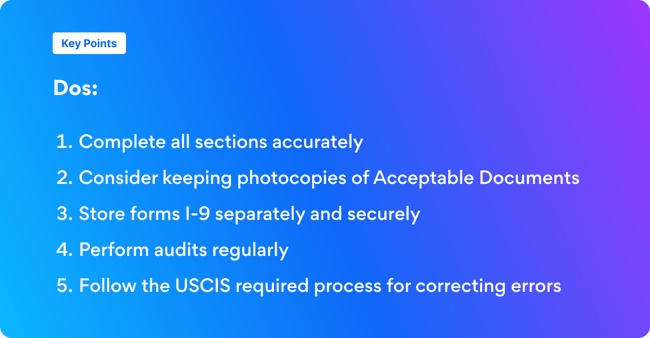
Your employee must fill out Section 1 (employee information), You (the employer) must complete Section 2 and Supplement B (employer information) completely and accurately, including dates and signatures. USCIS publishes an eight-paged instructions supplement that provides guidance on each field of the form. A copy can be downloaded from USCIS’ website.
Photocopy the original documents, as presented by the employee, and used by you to complete the Section 2 and Supplement B reverifications. Keeping copies of the documents also comes in handy for I-9 audits and verifying data accuracy. And if you use E-Verify, you may need these copies for comparison and photo matching during that process.
Keep I-9 forms and any additional supporting documentation in a separate, secured file (these documents contain confidential employee PII), apart from other personnel files, to ensure easy access for audits.
Review your I-9 forms to ensure proper completion and that they are the most current version, consistent with USCIS issuance controls.
If a form contains errors, draw a line through the incorrect information, enter the correct information, and have the employee initial and date the correction.
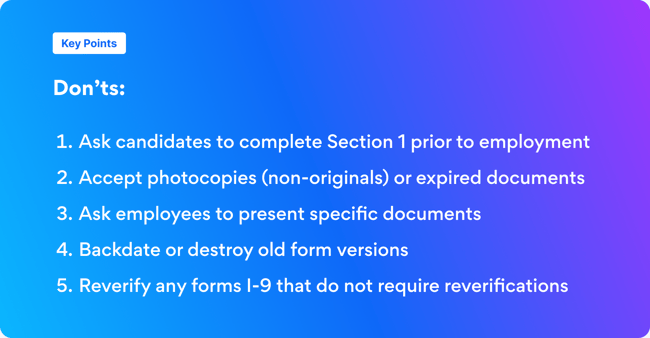
Section 1 should only be completed after the candidate has accepted an offer of employment and must be completed by the end of the first day of employment.
Employees must physically present you with original versions of their acceptable documents for examination, and they must be valid and unexpired. If the employee provides photocopies of their acceptable documents or expired documents, you can inform them that they are not acceptable and provide the employee a copy of the USCIS list of acceptable documents and request that they provide alternate documents from that list.
Federal law allows employees choose which documents they want to present from the USCIS list of acceptable documents, which includes a passport, permanent resident card, driver's license, social security card, and more. Even if you are trying to help an employee by suggesting common documents, it is best to refrain from influencing the employee’s decision.
You must maintain a clear paper trail of all forms, including forms that have corrections. Do not erase information or use white out to coverup incorrect information.
You should not reverify:
Keep these dos and don’ts in mind when you are working with the Form I-9. Speak to a Cisive expert today for an assessment of your Form I-9 process.



U.S. employers use Form I-9 for employment eligibility verification when hiring. That’s why you...
%20Verification%20-%20BLOG.png?height=200&name=BLOG_%20How%20to%20Streamline%20Social%20Security%20Number%20(SSN)%20Verification%20-%20BLOG.png)
Social Security number (SSN) verification is a critical process for employers looking to maintain...
.png?height=200&name=BLOG_%20SME%20-%20David%20Hair%20-%20New%20Form%20I-9%20NO%20CTA%20(1).png)
Are You Ready for DHS’ Alternative Procedure for Reviewing Employees’ Acceptable Documents for Form...