Finding the right candidate for a new job opening is no easy feat. Between analyzing résumés and...


The regulatory environment for hiring compliance is only becoming more complex. In 2026, hiring managers face new obligations around AI transparency, pay disclosure, worker classification, and state-specific onboarding requirements. At the same time, the enforcement of foundational hiring compliance areas like anti-discrimination and fair hiring practices continues to intensify.
This creates a dual challenge: Hiring managers must navigate emerging employment law while remaining rigorous on long-standing requirements. Organizations that fail to effectively train hiring managers face heightened risks of fines, audits, litigation, and reputational damage.
Hiring managers are on the frontline of recruiting compliance risk. Their decisions related to candidate evaluation, job postings, interview protocols, and onboarding processes will directly influence legal exposure, hiring fairness, and organizational integrity. When hiring manager training provides the right knowledge and workflows, the organization reduces risk and moves toward high-quality workforce outcomes. When this training falls short, compliance gaps multiply.
Before diving into specific training requirements, HR and compliance leaders need to understand what’s changed and where they should renew their focus. Several regulatory trends are converging in 2026. Some represent new obligations, while others reflect intensified scrutiny of existing requirements.
New compliance risks include stricter rules on AI use in hiring, expanded pay transparency mandates, heightened enforcement of worker classification, and revised state-level notice requirements for new hires. In addition, many ongoing foundational requirements continue to matter, including interview consistency, anti-discrimination protocols, documentation accuracy, and fair screening practices.
What makes hiring compliance particularly challenging in 2026 is multi-jurisdictional complexity. Hiring managers are often recruiting job applicants across states with vastly different wage laws, benefits statutes, and permissible background check rules. This fragmentation increases the likelihood of inadvertent noncompliance, especially when hiring managers rely on outdated templates or decentralized recruitment processes.
The takeaway for HR and compliance leaders is clear: Training must cover both emerging and foundational risks, and it must be regularly updated to reflect jurisdictional nuances. This isn’t a one-time effort. Compliance training is an ongoing strategic priority that protects the organization and strengthens hiring outcomes.
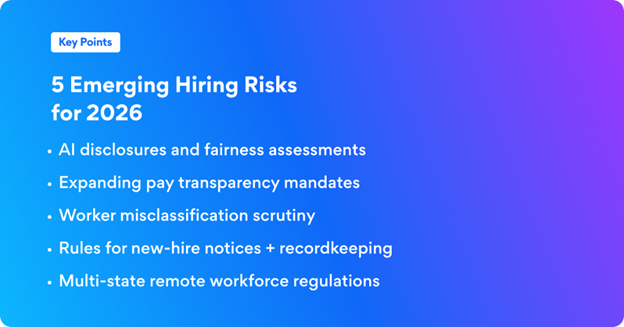
With the regulatory landscape defined, attention shifts to the specific emerging risks that demand immediate focus in 2026. Each of these areas introduces new obligations that hiring managers might not fully understand.
Artificial intelligence is reshaping recruitment, but it is also introducing new legal obligations.
Some states and localities now require employers to disclose when AI tools are used in hiring decisions. Some jurisdictions mandate bias-mitigation protocols or documentation of fairness assessments. Others impose data protection requirements for any candidate information that’s processed by automated systems.
Hiring managers often interact indirectly with AI-driven screening, ranking, or matching tools. They may not fully understand how these systems operate or what disclosures are required. This creates compliance blind spots, particularly when managers assume that technology vendors handle all legal requirements.
Training must clarify when AI disclosure is mandatory, what constitutes a "fairness assessment," and how to document the role of automation in hiring decisions. Managers should also understand that verified and accurate workforce data is essential whenever AI is involved, as flawed inputs can lead to biased outputs and legal exposure.
Pay transparency laws are expanding rapidly. More states now require employers to disclose pay ranges in job postings, provide compensation details during the hiring process, or share pay scales with current employees upon request. Additionally, some jurisdictions mandate pay equity audits and standardized reporting.
Each location’s legally required disclosures
How to interpret approved pay ranges in job posts and offer conversations
When to escalate compensation questions to HR or compensation teams
How to respond accurately and consistently when candidates ask about pay
This is particularly important because pay decisions are often tied to credential verification and role requirements. Transparent pay practices depend on validated job qualifications and consistent evaluation criteria. Training should emphasize the link between accurate screening, equitable pay structures, and compliance.
Federal and state authorities are intensifying enforcement related to worker classification. The distinction between contractors and employees carries significant implications for taxes, wages, and benefits. Misclassification can result in back wages, penalties, and litigation.
The level of control the employer exercises over work performance
The permanence of the relationship
Whether the work is integral to the business
When contractor arrangements are permissible and when they are not
Training should also address documentation expectations. Proper classification requires clear records of job duties, supervision structures, and the degree of independence afforded to workers.
Some states have adopted new requirements for the information employers must provide to new hires in writing.
These requirements vary by jurisdiction. For example, Oregon now requires employers to give written notice of pay rates, deductions, benefits, and other terms, with annual review mandates.
Which notices apply in each jurisdiction your business operates in
When they must be issued
How to ensure accuracy
The risks introduced by outdated templates or inconsistent onboarding pathways
The persistence of remote and hybrid work increases exposure to state and local labor laws, wage regulations, and benefits statutes.
Hiring managers may recruit candidates in states where the organization has never operated, introducing unfamiliar obligations for hiring compliance. Background screening requirements also vary by jurisdiction. What’s permissible in one state might be restricted or prohibited in another.
Managers must know when to escalate questions about location-specific rules to HR or compliance teams. Training should reinforce that multi-state hiring requires a unified, compliance-first approach to screening and onboarding. Systems should adapt automatically to jurisdictional requirements.
These emerging risks demand immediate attention, but they don’t replace the need for foundational hiring compliance practices. Both areas require equal focus in 2026 training programs.

While emerging risks demand attention, foundational compliance areas remain critically important. Regulators continue to scrutinize anti-discrimination practices, interview consistency, and documentation accuracy. Hiring managers who neglect these fundamentals could expose their organizations to significant legal and operational risk.
Hiring managers must understand what kinds of interview questions are prohibited, how to handle accommodation requests, and the importance of structured, consistent interview protocols. Treating candidates inconsistently undermines fairness and creates legal risk.
Training should reinforce that every hiring decision must be based on job-related criteria and documented clearly. Reducing unconscious bias in hiring requires both awareness and structured processes.
Outdated forms and templates can cause costly disputes or penalties. Hiring managers need access to current, localized job descriptions, offer letters, and onboarding documents.
Training should emphasize the importance of centralized, version-controlled hiring materials. When decentralized systems allow managers to create or modify templates without oversight, companies face increased risk of noncompliance and damage to their employer brand.
Research consistently shows that well-informed managers offer a front-line defense against compliance issues. Onboarding isn’t just about paperwork for managers. They must also understand how their decisions affect payroll compliance, benefits administration, and employee rights.
Hiring manager training should clarify how onboarding intersects with compliance obligations, including beyond the first day of employment.
State-level requirements for wage statements, schedules, and benefit disclosures often begin at the point of hire. Hiring managers need to understand how their decisions trigger payroll and benefits obligations and when to coordinate with finance or HR teams.
Even foundational tasks require precision. Training closes the gaps that lead to operational and legal risk. With emerging and foundational compliance risks addressed, the focus shifts to building effective training programs that actually work.
Understanding the problem is only the first step. HR leaders must now design training programs that address hiring compliance risks in practical, actionable ways. Effective hiring manager training must balance legal knowledge, operational skills, risk recognition, and technology proficiency.
Legal and regulatory knowledge. Managers should understand the rules governing AI use, pay transparency, worker classification, state-specific new-hire documentation, and permissible background checks. Training should clarify what’s required, what’s prohibited, and where ambiguity exists.
Operational skills. Managers need to know how to navigate screening workflows, interpret results consistently, follow escalation pathways when issues arise, conduct structured interviews, and accurately document hiring decisions. Training should be practical and scenario-based, going beyond just policy review. High-volume hiring scenarios also require specific operational rigor.
Risk recognition. Managers must be able to identify fairness or bias risks in selection decisions. They must also recognize incomplete applications, suspicious discrepancies in candidate data, and red flags in background checks. Training should develop judgment, not just hand out compliance checklists.
Technology and workflow proficiency. This is a critical gap to fill in 2026. Managers must know how to use applicant tracking systems (ATS) that are integrated with screening platforms. They must be able to confirm candidate consent and documentation, as well as utilize automated alerts, reminders, and compliance checkpoints.
Effective training teaches managers how to use compliance systems rather than memorize regulations. When clear training objectives are defined, the focus shifts to implementation and ongoing program management.
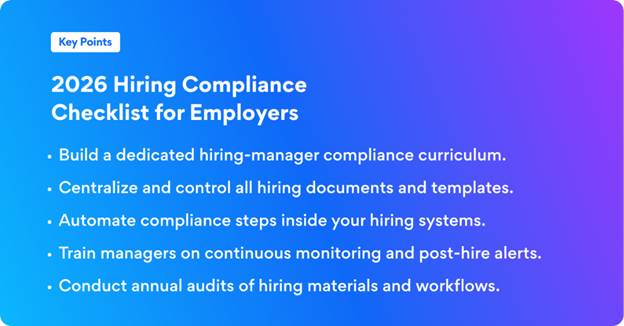
HR and compliance leaders should take the following steps to prepare hiring managers for 2026:
Create a 2026 hiring manager compliance curriculum. Include training modules on AI in hiring, pay transparency, worker classification, local laws, screening basics, and candidate experience. Update the curriculum annually to reflect regulatory changes.
Centralize hiring documentation and templates. Ensure all forms are current, tracked, and version-controlled. Restrict individual managers from creating or modifying templates without a compliance review.
Automate compliance steps within hiring systems. Ensure that technology enforces compliance best practices rather than over-relying on individual behaviors. Systems should automatically trigger the right checks for the right role and location.
Incorporate post-hire monitoring awareness. Compliance doesn’t end when the offer is accepted. Train hiring managers on how ongoing alerts and continuous monitoring influence workforce decisions.
Conduct annual hiring compliance audits. Review screening policies, job descriptions, interview guides, and onboarding materials against current laws. Identify gaps, and update training accordingly.
These hiring compliance recommendations provide a clear roadmap for implementation, but their effectiveness depends on sustained organizational commitment and leadership support.
The regulatory environment surrounding hiring will continue evolving. Hiring managers who receive the right training and tools become a critical line of defense. They reduce organizational risk, improve candidate experience, and strengthen workforce integrity.
Training is an ongoing task. Compliance obligations shift as laws change, and hiring managers need regular updates to stay current. Organizations that treat training as an ongoing strategic priority will be better positioned to navigate the complexities of 2026 and beyond.
Need help building your hiring compliance strategy for 2026? Our team works with HR and compliance leaders to design training frameworks, automate compliance checkpoints, and ensure hiring practices stay ahead of regulatory change. Contact a Cisive expert to discuss how your organization can strengthen hiring manager readiness and reduce compliance risk.
Author: Jenni Gallaway
Bio: Content Marketing Manager at Cisive. 8 years of experience in the background screening industry.
Let's Connect on LinkedIn


Finding the right candidate for a new job opening is no easy feat. Between analyzing résumés and...

A year of unprecedented challenges resulting from the global pandemic has dramatically shifted how...

Background screening in 2026 means navigating complexity at a local level. For example, “ban the...