CNAs, or Certified Nursing Assistants, are the eyes, ears, and hands of patient care. Often an...


Healthcare compliance leaders are operating under unprecedented pressure. Staffing shortages continue to strain organizations across the country, creating a tug-of-war between filling critical roles quickly and maintaining the rigorous screening standards that protect patients and preserve accreditation.
The risk isn’t that compliance teams try to cut corners. Stretched resources, compressed timelines, and manual processes create conditions where compliance degrades gradually through deferred checks, incomplete documentation, and assumptions that "someone else verified it."
This article examines where compliance breaks down during staffing shortages, why partial compliance is more dangerous than obvious gaps, and how healthcare organizations can stabilize their credentialing processes without slowing hiring to a halt.
Human resources and credentialing teams are stretched thin. They are hiring for revenue-generating roles, managing background checks, verifying credentials, and juggling competing priorities—all under pressure to fill roles "yesterday." Most rely on institutional knowledge rather than documented processes. This is not an isolated problem: 81% of healthcare executives believe talent shortages will significantly impact their strategies, making staffing pressure a systemic challenge across the healthcare industry.
When a background check returns unclear results or a license verification reveals an alias name, teams under pressure have less time to investigate. They face increased temptation to move forward regardless.
When experienced team members leave, undocumented steps disappear. New hires may not know to check for board actions on a license or verify all alias names in a criminal search.
Many organizations rely on travel nurses in multiple states, locum tenens providers, and telehealth clinicians licensed in multiple jurisdictions—each requiring verification across different state systems.
Spreadsheets don’t send alerts. Calendars don’t detect board actions. Email reminders don’t create audit trails. As volume increases, manual systems fail. Organizations that scale headcount without scaling compliance infrastructure face the greatest risk.
These conditions create environments where compliance violations become inevitable.
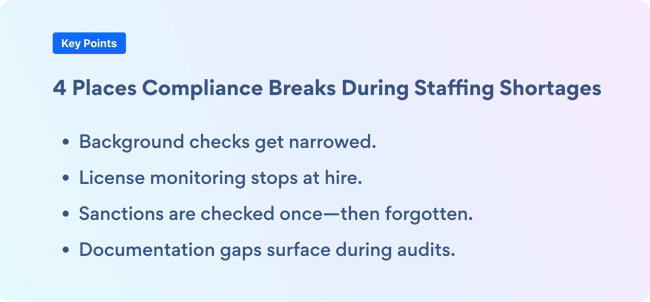
The following breakdowns are common, preventable, and often discovered only during audits.
Criminals change names, use aliases, and relocate to make records harder to find. Yet many organizations still search only the name on the application or limit searches to the candidate's county of residence.
What fails:
Best practice: Check all names and aliases at the county level, including both misdemeanors and felonies. Organizations can strengthen their approach by reviewing what state boards of nursing look for in background checks.
Many organizations verify a license at hire and assume the work is done. Teams struggling with slow credentialing processes often have no bandwidth left for post-hire monitoring.
What fails:
Best practice: Automate ongoing license monitoring to track status in real time. For organizations evaluating verification solutions, following license verification best practices for nurse practitioners and other providers is crucial.
Sanctions and exclusions lists are updated monthly. The absence of post-hire screening means an organization could employ an excluded individual for months before discovering an issue.
What fails:
Best practice: Implement monthly sanctions monitoring using automated tools. Organizations building comprehensive compliance programs should consider how sanctions screening fits within broader risk management strategies in healthcare.
If a compliance step is completed but not documented, auditors assume it didn’t happen.
What fails:
Best practice: Document every step, and store records centrally. Organizations looking to meet 2026 compliance requirements can use the 12 Days of Compliance framework as a roadmap for strengthening documentation practices.
These four areas represent the most common compliance failures during staffing shortages. Addressing them systematically reduces organizational risk and creates audit-ready processes that withstand scrutiny.
When nothing is checked, the problem is visible. An inconsistently followed process, however, creates a cover that gives organizations a false sense of confidence.
Leadership believes the organization is compliant because "we do background checks" or "we verify licenses." But incomplete processes create gaps that regulators will find. An absence of checks is an obvious problem. But when checks are performed inconsistently, the pattern can go undetected until an audit forces a review.
Regulators expect consistency. An organization that screens some hires thoroughly and others superficially can’t explain the difference without admitting to inadequate processes.
Most organizations don’t choose partial compliance; rather, it emerges unintentionally as teams make ad hoc decisions under pressure. For example, a hiring manager says, "We need this person on the floor Monday," so HR skips a verification step or accepts incomplete results.
Over time, these shortcuts become informal practice. No one sets out to create partial compliance. It emerges from a lack of standardization, documentation, and oversight.
The solution is consistency, not perfection. Organizations that define clear standards and apply them uniformly to new hires will create defensible compliance programs that withstand regulatory scrutiny.
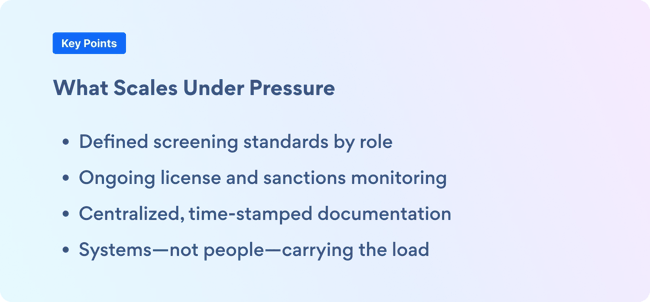
Healthcare organizations that maintain compliance during staffing volatility share a common characteristic: They don’t rely on individual effort. They rely on systems that function regardless of who is in the role or how urgent the hiring need becomes.
Two elements are essential to building these systems: repeatable processes that anyone can follow, and technology that handles the work humans cannot scale.
Effective compliance depends on clear standards that any team member can follow. The following elements create consistency without requiring heroic effort:
These practices allow organizations to move quickly without sacrificing defensibility.
Technology should handle:
Humans still own judgment and decisions:
Automation reduces manual work, but compliance leaders must still review alerts, investigate discrepancies, and ensure workflows function as intended.
With documented processes and technology that handles routine tracking, compliance scales without adding headcount. Organizations can absorb hiring surges, staff turnover, and operational disruptions without creating gaps that auditors will find.

Staffing shortages aren’t anomalies. They are a structural feature of the healthcare labor market, and compliance strategies must assume continued volatility.
Organizations that invest in clear processes, ongoing monitoring, and documentation discipline are better positioned to protect patients, preserve accreditation, and defend their hiring practices during audits. Compliance isn’t an obstacle to hiring. When done well, it reduces risk, creates consistency, and allows organizations to move quickly without cutting corners.
Healthcare compliance is categorically different from general employment screening. The regulations are stricter, the consequences are higher, and the healthcare workforce is more complex. PreCheck brings healthcare-specific expertise that directly addresses the challenges outlined in this article.
Regulatory expertise:
Purpose-built technology:
Operational continuity:
When compliance knowledge lives with one person, your organization is vulnerable. PreCheck provides the systems and expertise to maintain rigorous standards even during periods of extreme staffing pressure.
Talk to a PreCheck expert to learn how automated credentialing and ongoing monitoring can help your organization maintain rigorous standards for your healthcare professionals without slowing hiring.
Author: Chris Bolla
Bio: Healthcare Screening Specialist at Cisive PreCheck. Husband, Dad, Coach, Hack Landscaper.
Let's Connect on LinkedIn


CNAs, or Certified Nursing Assistants, are the eyes, ears, and hands of patient care. Often an...
If your organization hires nurses, you already know the stakes: One overlooked license issue or...

Hospitals, medical schools, and other healthcare organizations should screen medical students...