Hiring a commercial driver is more than just filling a seat in the cab of a truck. Every time a...


Operating a private fleet under "not for hire" authority won’t shield your organization from liability, insurance scrutiny, or reputational consequences when crashes occur. The distinction between private fleets vs. for-hire carriers may exist in regulatory classifications, but the operational risks are identical, regardless of operating authority.
Private fleet drivers navigate the same highways, operate similar equipment, and create equivalent third-party exposure as for-hire carriers. Yet many private fleets maintain screening standards that fall short of what leading for-hire carriers consider baseline practice. This gap creates unnecessary vulnerability in negligent hiring claims, insurance underwriting, and brand protection.
Private fleets often assume that lighter regulatory oversight justifies lighter screening practices. This is a costly misunderstanding. While private fleets may face different operating authority requirements under FMCSA definitions, they are functionally identical to for-hire operations in these areas: the vehicles they operate, the roads they travel, and the third-party exposure they create.
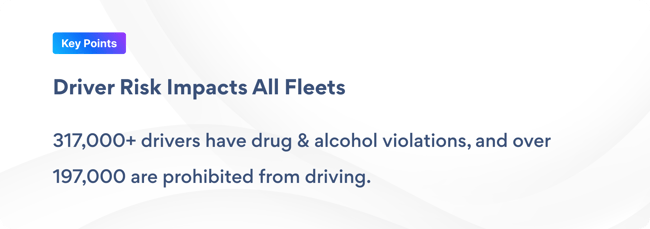
According to the FMCSA's Large Truck and Bus Crash data, commercial vehicle incidents continue to impose significant human and financial costs across all carrier types in the trucking industry. Meanwhile, the FMCSA Drug and Alcohol Clearinghouse reported more than 317,000 drivers with violations as of early October 2025, with over 197,000 in prohibited status.
These figures underscore the persistent risk of hiring drivers with disqualifying histories. More than 4.1 million people are registered as active commercial driver’s license (CDL) holders across all motor carrier types. Comprehensive employee background screening for fleets becomes essential for every fleet category.
Negligent hiring claims focus on whether an employer conducted reasonable due diligence before placing a driver behind the wheel. Federal Motor Carrier Safety Regulations (49 CFR Part 390) apply to private carriers operating commercial motor vehicles in interstate commerce, and they establish baseline driver qualification requirements.
If a private fleet driver with a history of driving while intoxicated, reckless driving, or prior crashes causes a fatality, plaintiffs are likely to argue that the employer failed to exercise the same care a reasonable carrier would have applied. In many jurisdictions, that "reasonable carrier" standard mirrors for-hire carrier screening standards rather than the regulatory minimum.
Insurers use crash statistics and safety measurement system data to evaluate driver qualification processes, the frequency of motor vehicle record (MVR) reviews, post-hire monitoring protocols, and safety performance data. Fleet managers who can’t demonstrate disciplined screening practices and clear disqualification criteria will likely face higher premiums, coverage restrictions, or difficulty securing capacity in a hardening market. Conversely, fleets that adopt carrier-grade practices can benefit from improved insurability and more favorable renewal terms over the long term.
The compliance gap isn’t a regulatory loophole, but rather a risk management failure that exposes private fleets to preventable losses.
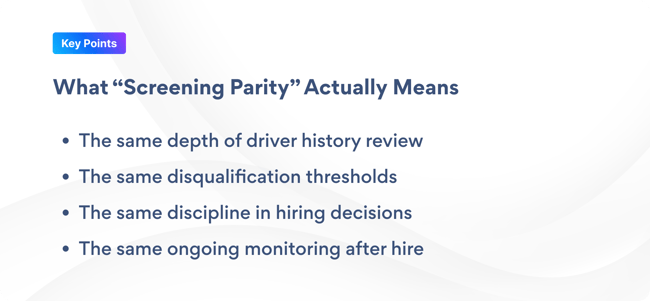
Screening parity doesn’t require private fleets to adopt every regulatory nuance applicable to for-hire carriers. Rather, parity means applying the same level of scrutiny to driver qualifications, conducting background investigations to the same depth, and maintaining the same discipline in disqualification decisions that meet FMCSA screening standards.
Multi-year MVR reviews that examine five to ten years of driving history, not just the most recent 36 months
Prior employer safety performance checks that go beyond employment verification to include crash involvement, safety violations, and termination reasons
Criminal history searches that assess offenses relevant to road safety and public trust (DUIs, reckless endangerment, violent crimes)
Drug and Alcohol Clearinghouse queries at hire and annually thereafter, identifying drivers with unresolved violations or incomplete return-to-duty processes
Clear, documented disqualification criteria that define what constitutes an unacceptable driving or criminal history, often by referencing FMCSA's guidance on driver qualification files
Ongoing monitoring through continuous MVR and criminal activity monitoring as well as the annual MVR pulls, random audits, and safety performance tracking.
Private fleets achieve parity by adopting and applying these practices consistently across all CDL roles and, where appropriate, non-CDL roles when operating company vehicles in high-exposure contexts. This approach proves cost-effective by reducing crash frequency, lowering insurance premiums, and avoiding the legal expenses associated with negligent hiring claims.
Parity isn’t about box-checking. Parity is about ensuring that every driver operating under your company's name and insurance meets the same threshold for safety and reliability. Resources like FMCSA's Driver Qualification File Checklist provide a baseline framework, but leading fleets go further by implementing continuous monitoring and tiered screening protocols.
Implementing screening parity requires more than policy updates. A sustainable framework integrates governance, clear hiring criteria, tiered screening by role, and post-hire monitoring to ensure Department of Transportation (DOT) compliance for private fleets.
Start by defining what "acceptable driver risk" means for your organization. Document disqualifying offenses (DUIs, reckless driving, at-fault crashes, license suspensions) and establish look-back periods that align with industry best practices. The FMCSA Licensing and Insurance database provides transparency into carrier safety records and can serve as a benchmark for understanding how regulators and insurers evaluate fleet performance.
Assign accountability for screening oversight to a designated safety or compliance leader. Conduct annual policy reviews to reflect regulatory changes and claims experience. Additionally, modern safety programs increasingly integrate electronic logging device (ELD) data with driver qualification files to create a comprehensive view of driver performance and compliance adherence.
Every CDL hire should undergo comprehensive driver background screening services, including a minimum three-year MVR review, a national background check covering criminal history, prior-employer safety verification (including crash and violation history), a Clearinghouse query, and employment verification covering at least three years. Non-CDL roles involving operating company vehicles in high-exposure scenarios should receive similar scrutiny that’s scaled to risk.
Adopt a phased approach that applies basic checks early in the hiring process (such as MVR and Clearinghouse queries in the application stage) and reserves resource-intensive checks for finalists (such as prior-employer safety verification and detailed criminal history). This approach balances thoroughness with efficiency and reduces costs associated with screening candidates who won’t advance. Tiered screening prevents bottlenecks while maintaining rigor, especially for any trucking company managing high-volume hiring.
Screening doesn’t end at hire. Conduct annual MVR reviews, perform Clearinghouse queries at least once per year, and establish a protocol for investigating incidents, near-misses, or customer complaints. Set requalification triggers (license suspensions, new violations, crashes) that prompt immediate review and, if necessary, driver removal. Continuous monitoring surfaces emerging risks before they result in claims or regulatory action.

Use this checklist to assess whether your private fleet screening practices match for-hire carrier standards.
Multi-year MVR review (3+ years) for all CDL roles
National criminal history search
Prior-employer safety performance verification (crash history, violations, termination reasons)
Drug and Alcohol Clearinghouse query
Employment verification (3+ years)
Disqualification criteria that are documented and consistently applied
Continuous MVR and Criminal activity monitoring
Annual MVR review for all active drivers
Annual Clearinghouse query
Incident investigation protocol with requalification triggers
Random safety audits and performance tracking
Clear process for driver suspension and/or removal based on new violations
Written driver qualification policy, reviewed annually
Assigned accountability for screening oversight
Training for hiring managers on screening standards and adverse action procedures
Audit trail for all screening decisions and disqualifications
If you can’t check most of these boxes, your fleet is operating below carrier-grade standards and may be exposed to preventable liability, insurance penalties, and reputational risk. FMCSA provides additional resources to help private fleets align with federal motor carrier safety expectations.
For additional guidance on screening trends in transportation, review industry benchmarks and the evolving best practices that leading fleets are adopting. Understanding common screening reports helps clarify what information each check provides and how to interpret results in the context of driver qualification decisions.
Implementing carrier-grade screening requires access to reliable data sources, compliant processes, and subject-matter expertise. A compliance-first background screening partner helps private fleets achieve parity without building in-house infrastructure or having to be regulatory experts.
Access to comprehensive data sources, including multijurisdictional MVR databases, national criminal repositories, and real-time Clearinghouse integration
Scalable workflows that support tiered screening, automated annual monitoring, and rapid turnaround for high-volume hiring
Compliance guidance that keeps pace with Fair Credit Reporting Act (FCRA) requirements, ban-the-box regulations, and state-specific adverse action procedures
Audit-ready documentation that demonstrates due diligence in every screening decision
Accuracy standards that reduce false positives, manual review burdens, and candidate friction
Cisive maintains a 99.9994% accuracy standard across its screening solutions, ensuring that hiring decisions rest on verified, defensible information. When compliance audits, litigation discovery, or insurance underwriting reviews scrutinize your driver qualification practices, your strong defense will be grounded in precision and documentation.
Achieve screening parity when you have the right partner, the right technology, and the right commitment to safety as a core value.
Private fleets that continue to apply weaker screening standards than their for-hire counterparts are making a conscious decision to accept higher legal exposure, worse insurance outcomes, and greater reputational risk. The regulatory distinction between operating authorities doesn’t protect your organization when a preventable crash occurs.
Adopting carrier-grade screening is about more than regulatory compliance. Parity recognizes that your drivers navigate the same roads, operate similar equipment, and create identical third-party exposure as any for-hire fleet. Courts, insurers, and the public evaluate your safety culture by that standard, regardless of your DOT classification.
Cisive helps you reduce hiring risk and strengthen every compliance audit with industry-leading background-check precision. Book a demo with a screening pro today.
Author: Greg Conklin
Bio: Transportation Screening Specialist at Cisive Driver iQ | Unmatched Screening Solutions for Smarter, Safer Hiring. Transportation is my area of focus. Father of two, former Jet Ski racer.
Let's Connect on LinkedIn


Hiring a commercial driver is more than just filling a seat in the cab of a truck. Every time a...

Every passenger who boards a motor coach makes an implicit assumption: the driver has been...
Keeping your fleet compliant and your drivers safe is a critical element of your fleet management....