In transportation, a safety-first culture isn’t measured by training manuals or mission statements....


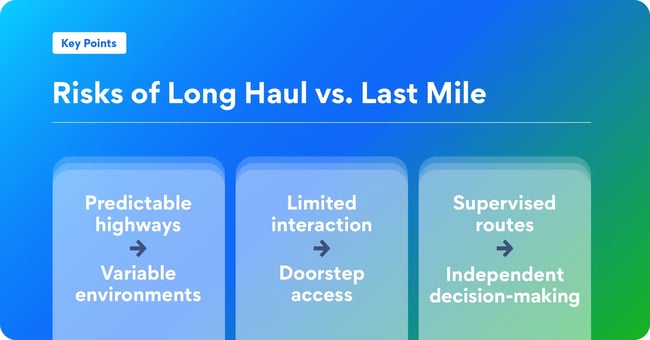
The final mile is where exposure peaks. Last-mile delivery places drivers in the most variable and uncontrolled environments in transportation. They navigate dense urban routes, make frequent stops, interact directly with customers, and often enter homes or secure buildings. Unlike long-haul operations with predictable highways and rest stops, last-mile work combines driving risk with customer interaction, residential access, and unsupervised decision-making.
These elevated risks demand last-mile background screening programs that address not just driving credentials, but also trust, behavior, and access. Effective final-mile delivery screening protects drivers, customers, and brand reputation in an environment where risk is constant and consequences are immediate.
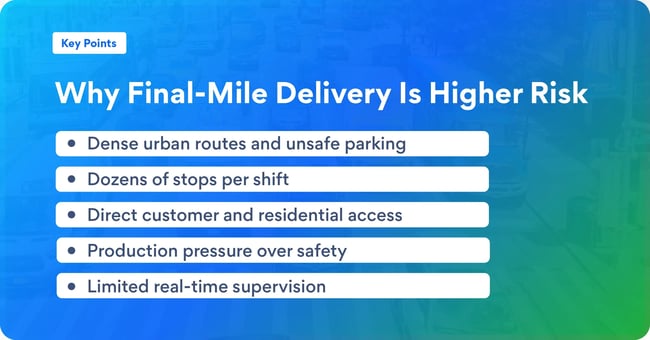
Last-mile delivery is distinct from other transportation roles. Drivers aren’t moving freight from point A to point B on predictable routes. They’re making dozens of stops per shift in variable conditions, often under intense production pressure.
Contributing factors include:
Research from the Office of the New York City Comptroller shows that last-mile facilities experience injury rates of approximately 8.3 cases per 100 workers—more than triple the U.S. private-sector average of 2.4.
A driver who delivers packages to residential addresses carries a different risk profile than one who drops trailers at distribution centers. Background screening programs must account for this expanded risk surface, protecting both the consumer who expects safe, professional service and the organization's legal defensibility.
Screening models designed for long-haul trucking or other transportation industry roles requiring a commercial driver’s license (CDL) can overlook final-mile risks. Common gaps include:
Many logistics companies run basic background checks that focus on driving-related offenses. This can create blind spots related to theft, violence, and trust-related offenses that become relevant when drivers have unsupervised access to customer property. Criminal records that reveal theft or violence convictions should be evaluated for relevance to residential delivery roles.
High-volume hiring and remote onboarding create opportunities for identity fraud. Without proper identity verification and authorization practices, carriers risk hiring individuals who misrepresent their identity, use false credentials, or have disqualifying histories under different names.
Checking motor vehicle records (MVRs) once per year creates an 11-month blind spot. In fast-paced delivery environments where drivers can accumulate violations quickly, annual MVR reviews fail to surface risk in time to intervene. Modern operations require more frequent monitoring. Creating real-time visibility into driving record changes allows organizations to address risk immediately rather than discovering violations months later.
Many last-mile operations rely on a mix of employees, independent contractors, and gig workers. Screening standards can vary by employment classification, creating inconsistent risk management and legal exposure. Base hiring decisions on role risk, not employment status. A driver might receive light screening because they’re classified as a contractor, but they still represent your brand and create potential liability when they knock on a customer's door.
Traditional screening can miss potential red flags. Instead of catching this early, companies find out when customer complaints surface undisclosed criminal history, when stolen packages are traced to drivers with theft convictions, or when crashes reveal that a driver's license was suspended months earlier. Partnering with a reliable background check company helps organizations prevent these exposures before they materialize.
Not all last-mile roles carry the same risk. Screening depth should align with role-specific exposure. A tiered risk framework helps organizations allocate resources appropriately:
Mapping screening depth to role risk improves safety and legal defensibility. This process focuses resources where exposure is highest and keeps hiring decisions consistent with the level of trust and access granted.
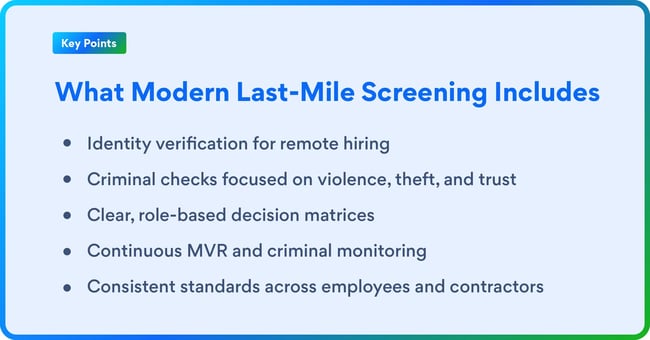
Effective last-mile screening programs combine several elements that are tailored to the unique risks of delivery work.
Identity verification and authorization practices confirm that the person being hired is who they claim to be. This is particularly important in remote hiring environments where in-person verification is not possible. Biometric tools, document authentication, and cross-reference checks help prevent identity fraud before it reaches the onboarding stage.
Standard background checks should include:
Understanding which screening reports to run for transportation roles helps organizations focus their efforts appropriately. Screening checks should follow standardized decision matrices that specify which offenses are disqualifying, which require individual assessment, and which lookback periods apply. This ensures that hiring decisions are consistent, compliant, and defensible.
Even if a CDL is not required, last-mile delivery drivers operate vehicles and represent the company brand on public roads. MVR checks should flag:
Establish clear minimum driving standards: No major violations or DUIs within X years and a cap on total violations and at-fault collisions, each tracked over a defined lookback period. Apply these standards across all driving roles to ensure every motor vehicle operator meets baseline safety requirements.
Last-mile operations depend on drivers showing up, completing routes, and returning vehicles and equipment. Employment verification surfaces patterns such as:
This information helps predict whether a candidate will be reliable under the demands of last-mile work.
Without clear criteria, hiring managers make subjective decisions that can introduce bias and legal exposure. Decision matrices define:
These matrices ensure that the same applicant background leads to the same hiring decision across candidates, reducing safety risk and the likelihood of discrimination claims.
Continuous criminal and MVR monitoring provides real-time tracking of driver record changes after hire. This allows companies to:
In high-turnover, high-volume operations, continuous monitoring is the only practical way to maintain visibility into driver risk as it evolves.

Roadway safety isn’t the only risk for final-mile operations. Workplace violence and customer interactions create risks that require complementary controls.
Transportation and material-moving jobs record thousands of workplace-violence cases that require days away from work each year. In logistics, studies show an underreporting of violence due to fear and perceived barriers, meaning actual exposure is likely higher than reported.
Background screening helps reduce exposure by filtering out candidates with violent criminal histories, but it must be paired with operational controls:
Customers judge delivery companies by who shows up at their door. A driver who is courteous, professional, and trustworthy reinforces brand value and customer satisfaction. A driver with a history of theft, violence, or erratic behavior creates liability and destroys trust.
Growth in last-mile delivery expands exposure if safety doesn't keep pace, too. The last-mile market is projected to more than double between 2023 and 2031, with approximately $83 billion of growth in the U.S. This growth increases both opportunity and risk. Companies that scale operations without scaling safety programs expose themselves to preventable losses.
Final-mile delivery demands screening programs that go beyond compliance minimums. Risks are elevated, exposure is multidimensional, and the consequences of inadequate background screening are measured in injuries, lawsuits, lost contracts, and damaged reputations.
Addressing transportation screening challenges requires specialized expertise that understands both operational demands and regulatory complexity. Modern screening technology makes it possible to scale hiring without sacrificing rigor. Ensure that growth doesn’t outpace safety by deploying Identity verification, continuous monitoring, and standardized decision frameworks.
Background screening is foundational to protecting people, property, and trust in the final mile. The question isn’t whether to invest in comprehensive screening, but whether you can afford the risk of not doing so.
Ready to build a last-mile screening program that protects delivery drivers, customers, and your brand? Talk to a screening expert to learn how Driver iQ helps delivery companies hire faster without compromising on safety, compliance, or customer trust.
Author: Carlo Solórzano
Bio: Senior Director of Sales and Business Development, Cisive Driver iQ.
Let's Connect on LinkedIn


In transportation, a safety-first culture isn’t measured by training manuals or mission statements....
Every year, carriers face audits that uncover missing driver records. Even one lapse can cost tens...

In the transportation industry, safety and compliance drive every decision—especially when it comes...