
The final mile is where exposure peaks. Last-mile delivery places drivers in the most variable and...


In transportation, a safety-first culture isn’t measured by training manuals or mission statements. It’s tested at the point of hire. Every hiring decision carries downstream consequences for public safety, insurance exposure, regulatory standing, and legal defensibility. One unsafe driver can trigger crashes, litigation, and insurance fallout that dwarf the cost of comprehensive background screening in transportation.
For carriers regulated by the Department of Transportation (DOT) and Federal Motor Carrier Safety Administration (FMCSA), transportation background checks are both a compliance requirement and the most controllable safety lever available before risk materializes on the road. Cutting corners on the screening process routinely produces long-term costs that far exceed any short-term savings.
Transportation is uniquely unforgiving when hiring goes wrong. Background screening serves as a critical risk mitigation tool in an industry where a single bad hire can cascade into devastating consequences.
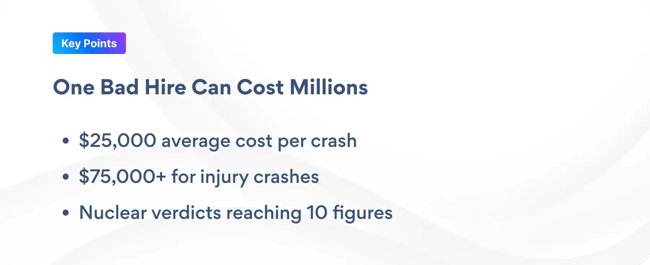
On-the-job crashes cost employers an average of $25,000 per incident, with crashes involving injuries averaging more than $75,000.
These figures do not account for the growing role of nuclear verdicts. Trucking cases can reach tens or hundreds of millions of dollars in damages. In one case, a jury awarded $1 billion, with Inadequate screening and missing qualification files proving central to the negligent-hiring finding. The jury found that the carrier failed to conduct proper background checks before hiring a driver who lacked proper licensing and was involved in multiple crashes.
Insurance premiums, CSA scores, and fleet insurability are often the first operational signals that a hiring mistake has occurred. For carriers transporting passengers, hazardous materials, or operating under government contracts, the consequences can multiply.
The bottom line: A single unsafe hire can be responsible for losses that exceed the carrier's annual screening budget many times over.
The best predictor of future behavior is past observed behavior. Background screening doesn’t measure perfection, but it does identify repeated noncompliance concerns by surfacing patterns that predict future safety performance.
The specific records that reveal safety-relevant behavior include:
Drivers often hold commercial driver’s licenses (CDLs) from multiple states. A CDLIS report reveals current CDLs and up to three past license registrations. Drivers frequently omit licenses on applications, particularly those associated with violations or suspensions. That’s where motor vehicle records (MVRs) come in. Pulling MVRs across all jurisdictions uncovers the full driving record.
The Pre-Employment Screening Program (PSP) provides five years of crash data and three years of roadside inspection history. These reports reveal compliance habits, not just outcomes. A driver with repeated inspection violations can demonstrate a pattern of noncompliance even if no crash has occurred.
The Previous Record of Employment (PRE) database contains millions of trucking employment records. Beyond dates of service, PRE records often include details such as:
What the driver was hauling
Why they left (termination, voluntary resignation, job abandonment)
Whether the employer would rehire them
Any accidents or incidents during employment
Drug and alcohol violations
A driver who is a serial job-hopper or who has abandoned trucks with loads in progress represents both a safety and operational risk.
The FMCSA Drug and Alcohol Clearinghouse flags drivers who are prohibited from operating commercial vehicles due to positive drug or alcohol tests. Checking the clearinghouse is mandatory for CDL hiring and prevents carriers from inadvertently hiring prohibited drivers.
Screening identifies patterns of behavior that create unacceptable risk before those drivers enter your fleet. Past safe behavior is the strongest available predictor of future safety performance.
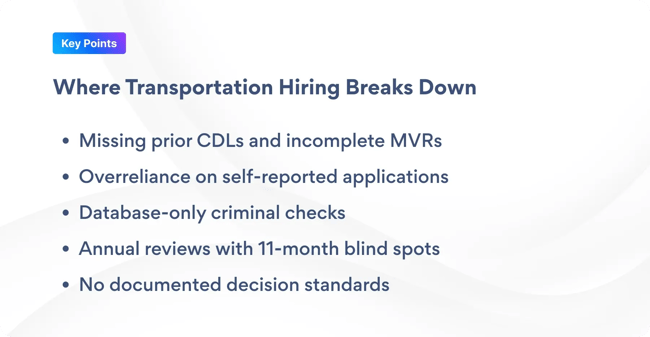
Despite regulatory requirements and known risk factors, many carriers maintain employment screening programs that fall short of best practices. Common gaps include:
Missing prior CDLs or incomplete MVR coverage. Relying solely on an applicant’s CDL disclosures can mean overlooking jurisdictions where violations occurred. Without CDLIS checks and multi-state MVR pulls, carriers operate with incomplete information.
Overreliance on self-reported applications. Industry data suggests that roughly one-third of job applicants misrepresent information on their applications. Without pre-employment verification, carriers accept these gaps as fact.
Database-only criminal checks without human review. Automated database searches can return false positives or miss records due to name variations, data entry errors, or jurisdictional gaps. Human review ensures accuracy and appropriate matching.
Collecting information that legally shouldn’t be considered. Decision-makers shouldn’t view certain information, such as arrests without convictions, expunged records, or offenses outside the legally permissible lookback period. Letting your hiring team see this information creates legal exposure even if it wasn’t consciously considered. Structured decision matrices and defined lookback periods prevent overreach and ensure consistent, defensible hiring decisions.
Lack of post-hire monitoring protocols. Many carriers pull background checks at hire and never again. A driver whose record deteriorates after hire—new arrests, license suspensions, or other serious violations—may go undetected for months until an audit or incident forces a review.
Unfortunately, these gaps are often exposed only after incidents occur, such as when plaintiff attorneys or regulators scrutinize hiring files and discover that basic verification steps were skipped.
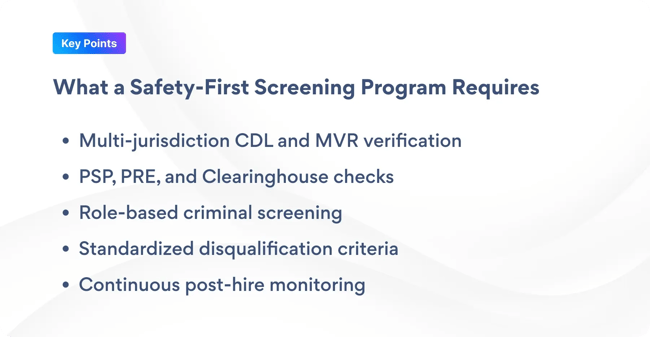
The most effective screening solutions go beyond DOT minimums and treat screening as a strategic risk control system. Creating a safety-first culture in the workplace starts with hiring decisions that are defensible, consistent, and aligned with operational risk. Key elements include:
FMCSA regulations require MVR checks, employment and safety-history verification (typically a three-year lookback), medical qualification, and drug screening within specific timeframes. Leading carriers exceed these requirements by:
Verifying all historical CDLs and pulling MVRs from each jurisdiction
Checking the PSP for crash and inspection history
Conducting comprehensive criminal background checks where job-relevant (e.g., theft risk for high-value cargo, violence risk for customer-facing roles)
Verifying employment through PRE and direct employer contact
Clear, written standards for what constitutes a disqualifying offense ensure that hiring decisions are consistent, defensible, and free from bias. Criteria should address:
Recent convictions for driving while intoxicated (DUI) or reckless driving
Patterns of serious moving violations
License suspensions or revocations
Falsified applications
Prior terminations for safety violations
Defined disqualification criteria and proper release practices reduce subjective judgment and protect carriers from claims of safety risk and discrimination.
Traditional annual MVR reviews create an 11-month blind spot. During that time, a driver may accumulate DUIs, suspensions, or other serious violations without the carrier's knowledge. Continuous MVR monitoring taps state motor vehicle databases to deliver near-real-time alerts when a monitored driver's record changes.
This allows carriers to:
Intervene immediately when violations occur.
Remove drivers from safety-sensitive duty pending review.
Improve CSA scores by addressing issues before they accumulate.
Demonstrate proactive risk management to insurers and regulators.
For drivers who enter secure facilities, transport high-value cargo, or interact with vulnerable populations, continuous criminal monitoring provides ongoing alerts when new convictions appear. This is particularly important for final-mile delivery, government contracts, and roles involving residential access.
Speed matters in hiring, but not at the expense of rigor. Integrated screening solutions prevent background checks from becoming bottlenecks. With the right partner, carriers can achieve fast turnaround times (closing most checks within 72 hours) while maintaining comprehensive verification standards.
The goal isn’t perfection. Rather, it’s vetting every driver who operates under your authority against known risk factors and documenting that effort in a way that withstands regulatory scrutiny.

A strong safety culture is ultimately proven through records, not rhetoric. When crashes occur, regulators, insurers, and plaintiff attorneys will scrutinize hiring files, monitoring practices, and policy consistency. Juries are no longer asking if a crash happened, but rather whether the company demonstrated its commitment to safety through reasonable preventive measures.
Documentation gaps are routinely fodder for negligent-hiring arguments. Missing employment verifications, incomplete MVR histories, or exceptions to stated hiring policies become evidence of inadequate due diligence.
Leading carriers track metrics that demonstrate safety performance improvements, including:
Crash frequency and severity: Look for reductions in crash rates and average crash costs compared to baseline periods before implementing enhanced screening. Fewer workplace injuries translate directly to lower operational and insurance costs.
Insurance claims and premiums: Aim to lower claims frequency and premium costs attributable to improved driver selection and monitoring.
Audit performance: The absence of driver qualification violations in DOT and state inspections, or a “clean” audit, demonstrates that your workplace culture transforms leadership intent into operational execution.
Time to hire without increased risk: Develop automated workflows that expedite screening without sacrificing thoroughness. Carriers who partner with specialized screening providers like Cisive experience an average 31.8% reduction in time to fill while maintaining rigorous standards.
Contract retention and acquisition – Documented safety programs strengthen competitive positioning when bidding for contracts with clients that require safety certifications. A strong safety culture becomes a differentiator in the transportation industry.
Modern screening technology makes it possible to achieve both speed and accuracy. A wide majority of background checks close in under an hour when carriers partner with providers that deliver automation, human review, and transportation-specific expertise.
Background screening is one of the few safety investments that pays off even when nothing goes wrong. By filtering out high-risk drivers before they reach passengers or freight, carriers reduce crash exposure, lower insurance costs, and demonstrate to regulators, insurers, and clients that safety culture starts with hiring decisions. A work environment built on accountability and verification protects everyone.
A single injury crash can wipe out years of background-check savings, with the costs of an on-the-job crash commonly running into tens of thousands of dollars before litigation even begins. In contrast, the cost of comprehensive transportation background checks is a fraction of potential losses while providing measurable safety improvements, reducing liability exposure, and strengthening your competitive position.
In transportation industries, safety and trust depend on who you hire and how well you can prove it. Safety training and operational controls matter, but they can’t compensate for hiring decisions that introduce preventable risk from day one.
Ready to build a defensible screening program? Talk to a screening expert to learn how Driver iQ's transportation-focused approach helps carriers hire faster without compromising on accuracy, compliance, or passenger trust.

Author: Carlo Solórzano
Bio: Senior Director of Sales and Business Development, Cisive Driver iQ.
Let's Connect on LinkedIn


The final mile is where exposure peaks. Last-mile delivery places drivers in the most variable and...

If you own or operate a trucking company, you already know how important it is to ensure your...
Every year, carriers face audits that uncover missing driver records. Even one lapse can cost tens...